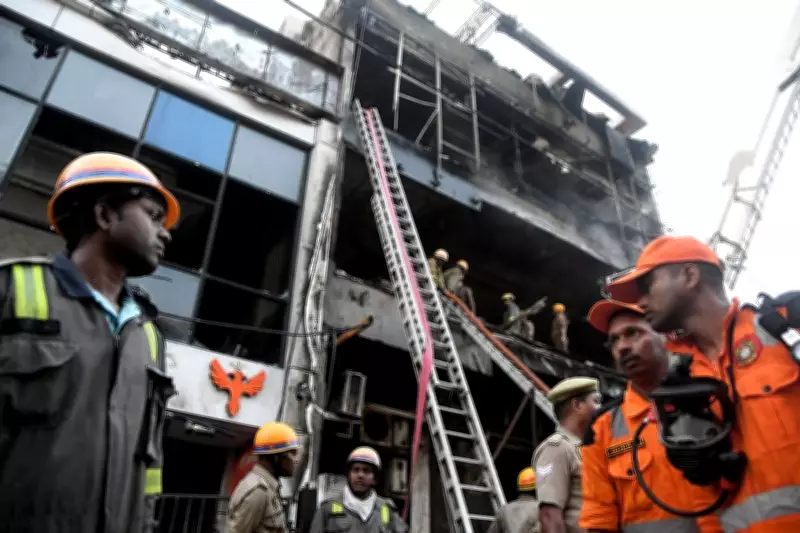
Preliminary findings indicate that the Aliganj building was operating as a multi-storey commercial establishment despite reportedly having approval only for a residential ground floor. The discovery of building and safety violations at the Lucknow commercial complex where 18 people died has once again brought attention to a recurring concern in Indian cities: safety norms often come under scrutiny only after a tragedy.
Regulatory Lapses and Building Violations
Investigators are examining the absence of mandatory fire and electrical safety clearances, questions over power usage and the presence of a single entry-exit point in a building that housed a pet shop, warehouse, gaming zone, coaching classes, and an animation training centre. The findings have drawn parallels with recent fire tragedies, including the Malviya Nagar blaze in Delhi, where concerns over compliance and enforcement also surfaced in the aftermath. In both cases, the focus has shifted beyond the immediate cause of the fire to the larger question of whether warning signs were overlooked before disaster struck.
As investigators began examining the circumstances behind the tragedy, preliminary findings pointed to serious regulatory lapses. Officials found that the building had approval only for a residential ground floor, but a four-storey commercial structure was operating from the premises. The building allegedly did not possess mandatory no-objection certificates from the fire and electrical safety departments despite housing a pet shop, warehouse, gaming zone, coaching classes and an animation training centre. Authorities also found that the premises had a sanctioned electricity load of 20 kilowatts but was reportedly drawing 35.50 kilowatts. The property is registered in the name of Virendra Prasad Shukla, while the building plan was approved in the names of Surendra Shukla and Dhirendra Shukla. The findings are expected to form a key part of the inquiry ordered by the state government into the disaster that claimed 18 lives.

Arrests and Suspensions
Even as a criminal case was registered against six named accused and other persons found responsible. An FIR has been lodged at Aliganj police station under Sections 110, 105, 125 and 3(5) of the Bharatiya Nyaya Sanhita, along with Sections 6 and 10 of the Uttar Pradesh Fire Service Act. Those arrested have been identified as Ramkrishna Upadhyay (43), Virendra Prasad Shukla (62) and Tushok Krishna Jaiswal (31). The arrests came amid mounting scrutiny over alleged violations related to building approvals, fire safety clearances and the operation of multiple commercial activities from the premises where the deadly blaze occurred.
Meanwhile, upon Chief Minister Yogi Adityanath’s direction, official informed of suspending four govt officials. The suspended officials are Gaurav Kumar, Executive Engineer in the Electricity Department; Kamlendra Kumar Singh, Fire Safety Officer, Indira Nagar; Anil Kumar, Assistant Engineer with the Lucknow Development Authority (LDA); and Pramod Kumar, Junior Engineer, LDA.
Origin of Fire and Investigation
Preliminary findings indicate that the fire may have originated in the building’s air-conditioning duct system. Uttar Pradesh Urban Development and Energy Minister AK Sharma said thick smoke spread rapidly through the structure, leading to suffocation among those trapped inside. Sharma said a detailed probe would examine the cause of the blaze, compliance with building safety norms, and any lapses by responsible authorities. “Strict action will be taken against those found guilty,” he said.
Officials and eyewitnesses also pointed to the absence of adequate emergency exit routes as a key factor behind the high number of casualties, suggesting that the lack of safe evacuation options worsened the tragedy. As inquiries proceed in Lucknow, the tragedy is emerging not only as a story of lives lost and dreams cut short, but also as a stark reminder of the consequences when safety regulations exist on paper but fail in practice.