CJI Surya Kant Calls for Disciplining Technology in Justice Systems
In a significant address at the closing ceremony of the 2nd Supreme Court Advocates-on-Record Association International Legal Conference in Panaji, Chief Justice of India Surya Kant articulated a nuanced vision for the judiciary in the technological age. Speaking on Sunday, Justice Kant emphasized that the contemporary challenge for justice systems is neither to resist technological advancements nor to surrender to them completely, but rather to discipline innovation so it serves justice rather than dominates it.
Balancing Efficiency with Human Judgment
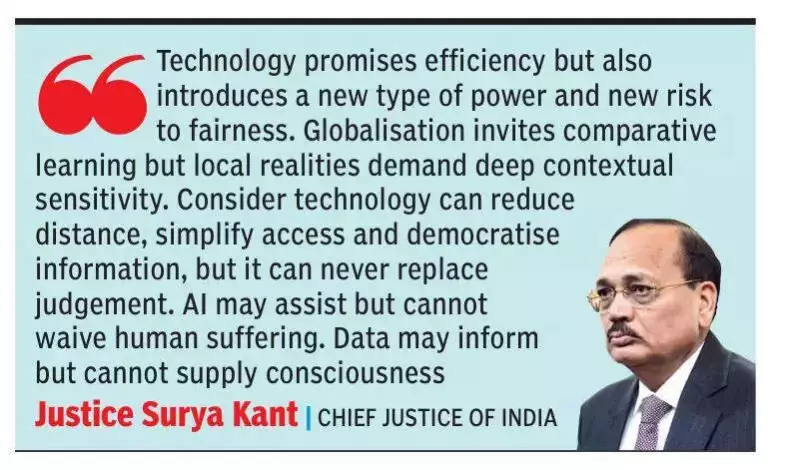
The CJI highlighted the complex pressures facing modern courts, which are expected to operate faster while exercising greater caution, become more accessible yet maintain judicial restraint, and enhance transparency while remaining insulated from fleeting societal trends. Technology promises unprecedented efficiency, he noted, but simultaneously introduces new forms of power and risks to fairness that must be carefully managed.
"Consider technology can reduce distance, simplify access and democratise information, but it can never replace judgement," Justice Kant stated. "AI may assist but cannot waive human suffering. Data may inform but cannot supply consciousness." This perspective underscores the irreplaceable role of human discernment in legal processes, even as digital tools transform how justice is administered.
Emerging Challenges in Legal Landscape
Looking ahead, the Chief Justice identified several critical areas where technology will test legal frameworks. Artificial intelligence will raise novel questions of accountability, particularly regarding decision-making processes and liability. Climate change issues will challenge traditional notions of intergenerational justice, requiring courts to consider long-term environmental impacts. Digital platforms continue to blur boundaries between free expression and potential harm, creating tensions between speed of communication and fairness in legal proceedings.
"None of these challenges admits of easy answers," Justice Kant acknowledged, pointing to the growing complexity facing legal professionals worldwide. The globalization of legal practice invites comparative learning from international jurisdictions, yet local realities demand deep contextual sensitivity that cannot be automated or standardized.
Embracing Alternative Dispute Resolution
A significant portion of the CJI's address focused on the expanding role of alternative dispute resolution mechanisms, particularly mediation. He framed mediation not as a retreat from traditional adjudication or an abdication of judicial responsibility, but as recognition of an important truth about conflict resolution.
"Not every dispute requires a verdict, and many require something far more difficult — dialogue, understanding and closure," Justice Kant explained. Mediation represents a sophisticated approach to justice that acknowledges different pathways to resolution beyond formal judgments.
The Chief Justice argued that a mature justice system must understand not only how to decide disputes but also when to resolve them through alternative means. "Courts, by embracing mediation as a core institutional value, do not weaken their authority but preserve it by ensuring that justice remains humane, timely and responsible to those it serves," he asserted.
Future Directions for Indian Judiciary
Justice Kant's address comes at a pivotal moment as Indian courts increasingly integrate technology through initiatives like e-filing, virtual hearings, and digital case management systems. His remarks provide philosophical guidance for this digital transformation, emphasizing that:
- Technological tools should enhance rather than replace human judgment
- Efficiency gains must not compromise fundamental fairness
- Global best practices should be adapted to India's unique legal context
- Multiple dispute resolution mechanisms strengthen rather than weaken judicial systems
The conference gathering of legal professionals provided an appropriate forum for these reflections, as advocates and judges collectively consider how to navigate the intersection of law and technology while preserving the human elements essential to justice.