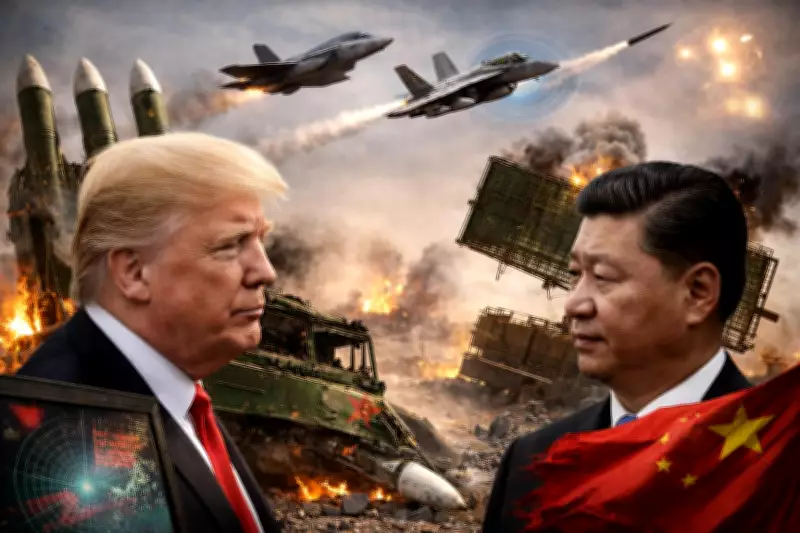
China's Military Tech Credibility Cracks as Air Defense Systems Fail in Global Conflicts
China's image as a rising military technology powerhouse has come under intense scrutiny following a series of international conflicts that exposed significant shortcomings in its defense systems. Air defense equipment, promoted by Beijing as advanced and reliable, has faced serious questions after failing to prevent major military operations in Pakistan, Venezuela, and most recently Iran. These incidents have prompted defense experts and policymakers worldwide to examine whether Chinese systems perform as advertised when confronted with technologically sophisticated adversaries.
Growing Questions Over China's Air Defense Systems
For years, Chinese leaders showcased systems like the HQ-9B air defense missile and associated radar technologies at military parades and defense exhibitions. Marketed as a powerful long-range shield capable of tracking and destroying multiple targets simultaneously, the HQ-9B is widely viewed as China's flagship surface-to-air missile system. Developed by the China Aerospace Science and Industry Corporation, it draws inspiration from American and Russian platforms, designed to intercept threats at ranges up to 260 kilometers.
However, recent battlefield performances outside China have raised serious doubts. Critics argue that these systems, impressive in displays, have struggled in real combat conditions, appearing "blind, deaf, and mute" during critical operations.
Pakistan: Early Warning Signs During Operation Sindoor
Concerns first intensified after India's Operation Sindoor, launched in response to the Pahalgam terror attack. During this operation, Indian forces carried out precision strikes targeting militant and military infrastructure across the border. Military assessments revealed that Chinese-supplied air defense systems deployed by Pakistan, including the HQ-9 and HQ-16, struggled to intercept incoming threats.
Reports suggested that missiles and aircraft repeatedly penetrated the defensive shield, with the HQ-9B soundly defeated for four consecutive days. Fragments of a failed Chinese PL-15 air-to-air missile were later displayed by Indian officials, adding to reliability questions. This episode sparked concern among countries like Pakistan, which sources 82% of its military imports from Beijing.
Venezuela Operation Exposes Radar Vulnerabilities
Doubts deepened during a dramatic American military operation in Venezuela, where US forces captured leader Nicolás Maduro without fatalities. The mission exposed vulnerabilities in Venezuela's radar network, which included Chinese-supplied JY-27A early warning systems. Promoted as capable of detecting stealth aircraft, these radars failed to detect any of the 150 aircraft that penetrated Venezuelan airspace, becoming a point of national humiliation.
Electronic warfare aircraft like the EA-18 Growler reportedly neutralized the defense system, highlighting gaps in Chinese technology against advanced US capabilities.
Iran Strikes Intensify Scrutiny
The most recent test came during large-scale US and Israeli strikes on Iran, targeting over 20 provinces. Iran's layered air defense, anchored by the HQ-9B alongside Russian systems, failed to prevent extensive destruction, including deadly strikes on high-ranking officials. Analysts are examining whether technical limitations or saturation tactics overwhelmed the system, with electronic warfare and stealth aircraft potentially degrading defenses early in the attack.
Export Credibility Under Pressure
China has become a major arms exporter, selling equipment across Asia, Africa, and beyond. However, these conflicts have led observers to question the reliability of Chinese systems in high-intensity warfare. While cost-effective compared to Western alternatives like the Patriot system, critics argue lower prices may compromise reliability and technological maturity.
Strategic Implications for Taiwan
The debate carries broader geopolitical implications, with some analysts believing that China's military credibility loss could influence perceptions regarding Taiwan. Although Beijing remains a nuclear power with expanding forces, its combat technology has proven vulnerable compared to the US, offering hope to Taiwan amid ongoing tensions.
US Military Dominance Remains Intact
Recent events reinforce that the United States retains global military dominance, with operations in Venezuela and Iran showcasing speed and precision. Supporters argue that US technological superiority and decisive action have reshaped the strategic landscape, uniting allies against threats like Iran.
A Global Power Balance in Transition
China remains an economic powerhouse, but the gap in military technology, especially in air defense and electronic warfare, appears significant. The effectiveness of Chinese defense systems is likely to remain under intense scrutiny as analysts dissect recent conflicts, placing Beijing's defense industry in an unprecedented spotlight.