The Border Security Force (BSF) has activated a sophisticated, multi-layered security grid built on indigenous technology to counter a significant surge in drone activity originating from Pakistan. This integrated system is a direct response to the increasing use of unmanned aerial vehicles for smuggling and infiltration across the western frontier.
An Evolving Technological Shield
BSF Additional Director General (Western Command) Satish S Khandare, addressing the media on Tuesday, detailed the new measures. The security grid combines radar, electro-optical and infrared cameras, and radio-frequency analyzers to form a cohesive network for detecting, tracking, and neutralizing hostile drones. Khandare acknowledged that anti-drone technologies are still evolving, noting that "accuracy is not very high, and results vary." However, he emphasized that coordination with other security agencies remains excellent.
A key component being deployed is the Electro-Optical Targeting System (EOTS). These are passive, camera-based sensors that can be fused with radar data for long-range observation and visual identification in all weather conditions. "Once a target is detected by radar or other sensors, EOTS helps identify and assess whether the movement is friendly or hostile," Khandare explained.
Forensics, Flood Damage, and a Shifting Mandate
Highlighting the seriousness of the drone threat, the ADG revealed that the BSF has established a state-of-the-art drone forensics laboratory in Amritsar. Every recovered drone undergoes a complete analysis to determine its flight history, drop points, and the hotspots involved. This forensic capability has significantly strengthened the force's ability to manage drone-related threats.
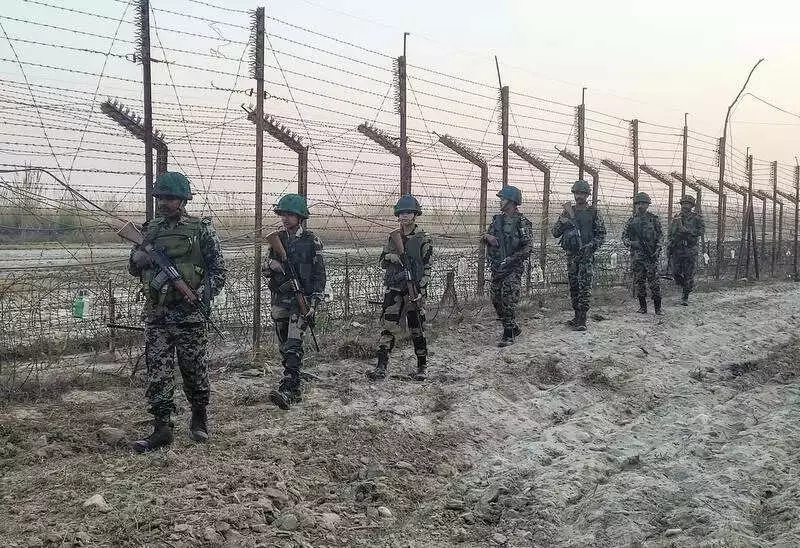
Khandare also disclosed a major physical vulnerability: recent floods in Punjab washed away nearly one-third of the border fencing. This damage, spread across multiple non-contiguous locations, created temporary gaps that Pakistan-based elements attempted to exploit. "Some attempts were made from the Pakistan side for infiltration, but BSF, along with Punjab Police, conducted operations and seized weapons. We quickly regained control on the ground," he stated. Fencing in parts of Jammu was also affected but has been swiftly restored.
The BSF's role is evolving beyond preventing physical infiltration. "We are also deployed in depth to counter technological infiltration, which is now a regular tactic from across the border," Khandare noted. To bolster the anti-infiltration grid in Jammu, two additional battalions have been deployed.
Recoveries, Upgrades, and Future Preparedness
The statistics underscore the scale of the challenge. So far in 2025, the BSF's Western Command has recovered 278 drones. This marks an increase from 250 drones recovered in 2024 (with 242 along the Punjab border) and 107 in 2023. Alongside drones, the force has seized over 380kg of heroin and more than 200 weapons this year, and apprehended 53 Pakistani intruders and smugglers till December 2.
Looking ahead, the BSF is undertaking several infrastructure projects. Massive connectivity work is linking border outposts with each other and the hinterland. Lateral and axle roads are being developed in Punjab to improve force mobility. The existing, aged border fence is being systematically replaced with a new-design barrier. Furthermore, anti-tunnel systems have been developed in Jammu and Punjab to detect underground routes, and vulnerable riverine gaps are being secured with command posts and reinforced manpower.
The force is also collaborating with leading institutions like the IITs to keep pace with rapid technological advancements. As the BSF celebrates its diamond jubilee, having grown from 25 battalions in 1965 to 193 battalions today, its mandate on the 553-km Indo-Pak border in Punjab (518km land, 33km riverine) is becoming increasingly technology-intensive.