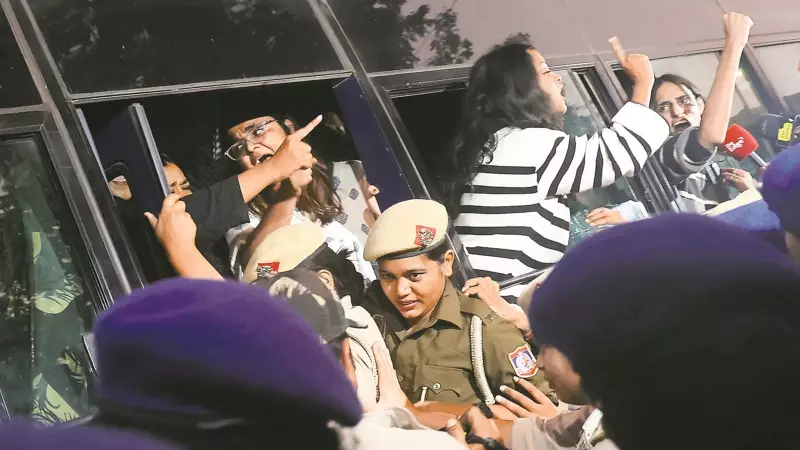
A Delhi court on Tuesday granted bail to nine individuals, predominantly college students, who were arrested last week during a demonstration against severe air pollution at the capital's iconic India Gate. The protest, which took place on November 23, saw allegations of police personnel being attacked with pepper spray.
Two Separate FIRs and Court Proceedings
The legal actions stem from two distinct First Information Reports (FIRs) filed by the Delhi Police. In the first case, registered at the Parliament Street police station concerning an alleged scuffle between protesters and police, all 17 accused have now been released on bail. While eight were granted bail last week, the remaining nine received bail on Tuesday from Judicial Magistrate First Class (JMFC) Sahil Monga of Patiala House Court.
The second FIR, lodged at Kartavya Path police station, is more serious, involving allegations related to the recovery of pepper sprays and investigating potential Naxalite connections of the protesters. In this case, the court has reserved its order on the bail pleas of seven individuals. The decision is expected to be announced on Thursday. Overall, 21 out of the 23 detained protesters have been named as accused across these two cases.
Court's Reasoning for Granting Bail
While granting bail in the first case, JMFC Sahil Monga noted that concerns about the accused absconding or tampering with evidence could be addressed by imposing reasonable bail conditions. He emphasized that further custodial detention was unnecessary as the investigating officer had not sought police custody and the ongoing investigation did not appear to require their incarceration.
The magistrate made a clear distinction between the two FIRs. He observed that a significant portion of the objections raised by the police pertained to the investigation in the second FIR (102/25), including allegations about the protest, recovery of pepper sprays, and criminal antecedents. "These pertain to a different incident and cannot be a ground to oppose bail in the present FIR," JMFC Monga stated.
Arguments from Defence and Prosecution
In the second case before JMFC Aridaman Singh Cheema, defence lawyers vehemently argued for bail. They contended that merely being part of WhatsApp groups which organized the air pollution protest was not a criminal act, and that the events at the protest site were beyond their clients' control. One counsel argued, "Their future is bright, they'll work for the country," while another pointed out contradictions in the police's replies, stating, "You can't swim in two boats. Earlier they said someone else had pepper spray, now they're pinning it on my client."
The defence also challenged the police's need for custody to examine digital records and asserted that raising anti-establishment slogans is not illegal. On the other side, the prosecution argued that police custody was essential as the investigation was ongoing and that the protesters had not sought permission for the demonstration. Police had earlier claimed the accused supported a banned organization on social media and shared articles supporting Maoist commander Hidma.
The court scrutinized the police's claims, with JMFC Cheema asking them to check Hyderabad call detail records when they alleged a suspect met "key conspirators" there. A defence lawyer retorted, "Is going to Hyderabad suspicious?... they're clutching at straws. People can't be sent to 20 days in prison for a scuffle with the police."
The protest on November 23 began as a gathering against the capital's hazardous air quality but escalated after police claimed participants "raised slogans in support of Naxalites." At least 80 protesters were initially detained during the incident at India Gate.