

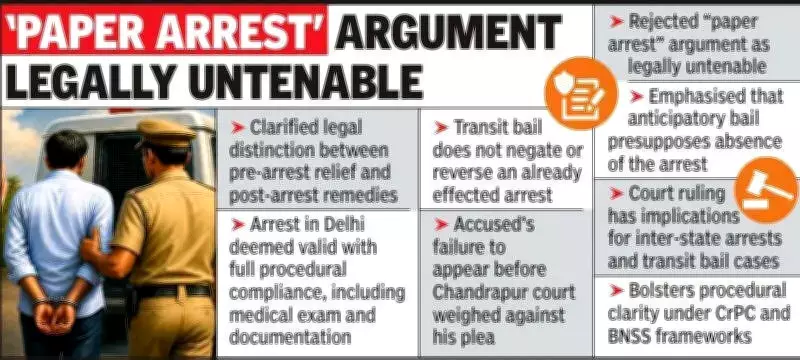
The Nagpur bench of the Bombay High Court recently delivered a significant ruling clarifying the scope of pre-arrest relief. The court held that an anticipatory bail application is not maintainable once an accused has been arrested, even if transit bail has been granted.
Case Background
Justice Rajnish Vyas presided over a case involving a Nagpur-based man who was arrested in Delhi in connection with an FIR registered by Brahmapuri police in Chandrapur. The accused faced serious charges under the Indian Penal Code, the Maharashtra Money-Lending (Regulation) Act, and provisions related to illegal organ transplantation.
Central Issue
The court framed the central issue around whether an accused who has been arrested, produced before a magistrate, and released on transit bail can still invoke Section 438 of the Code of Criminal Procedure dealing with anticipatory bail or relevant provisions under the BNSS, 2023.

Court's Ruling
Rejecting the plea, the court held that the arrest was duly effected in Delhi. The accused was apprehended, produced before a magistrate, and furnished with grounds of arrest. "Once arrest is done, the remedy shifts from Section 438 to regular bail," the court observed, adding that pre-arrest protection was not at all available thereafter.
Petitioner's Arguments
The petitioner argued that his arrest was merely a "paper arrest" since transit remand was denied and he was granted transit bail. He contended that the possibility of re-arrest justified his move to seek anticipatory bail.
Government's Opposition
Opposing his contentions, government pleader and senior counsel Deven Chauhan argued that the petitioner was in constructive custody and had already submitted to the jurisdiction of the magistrate's court. "He had given an undertaking he would appear before the jurisdictional court at Chandrapur, which disentitles him from claiming anticipatory bail," Chauhan said.
Court's Observations
The court found "no substance" in the petitioner's claim and pointed to compliance with due procedure, including arrest documentation, medical examination, and communication to family members. Further, it noted that the accused had undertaken before the Delhi magistrate to appear before the Chandrapur court but failed to do so and instead sought anticipatory bail. This conduct, the court indicated, weakened his claim for relief.
Legal Principles
Addressing broader legal principles, the court emphasised that while anticipatory bail safeguards personal liberty, it presupposes absence of arrest. "The transit bail will not undo arrest made by police," the order stated, rejecting reliance on precedents cited by the applicant. Citing Supreme Court rulings, the court reiterated that an accused is deemed in custody once he submits to the jurisdiction of a court. It concluded: "Application for anticipatory bail is not maintainable once an arrest is effected, irrespective of grant of transit bail."






