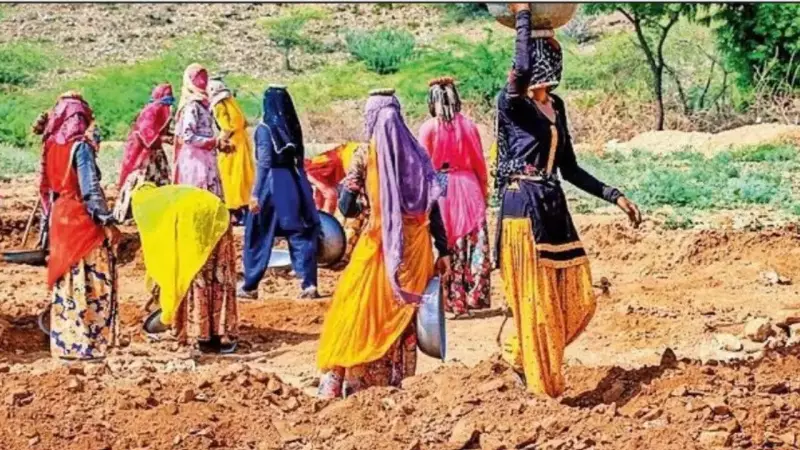
The Narendra Modi-led government is poised to introduce a landmark new legislation that will effectively replace the Congress-era Mahatma Gandhi National Rural Employment Guarantee Act (MGNREGA). The proposed law, titled the 'Viksit Bharat Guarantee for Rozgar and Ajeevika Mission (Gramin) (VB-G RAM G) Bill, 2025', aims to overhaul India's rural job guarantee framework with significant structural and financial changes.
Key Features of the New Viksit Bharat Guarantee Bill
The new bill promises to increase the guaranteed employment for a rural household from the current 100 days under MGNREGA to 125 days. However, it introduces a fundamental shift in how the scheme is funded and operated. Under the proposed Act, the financial burden will be shared between the Centre and states in a fixed ratio. The Centre will bear 60% of the cost, while states will shoulder the remaining 40%. For the northeastern states and the hill states of Uttarakhand, Himachal Pradesh, and Jammu & Kashmir, the fund-sharing formula will be a more favourable 90:10 between the Centre and the state.
This marks a major departure from MGNREGA, where the Centre bore the entire cost of labour wages and 75% of the material cost. The new scheme will operate as a centrally sponsored scheme with a flat cost division, eliminating the separate distinctions for labour and material costs.

A Fixed Budget, Not Demand-Driven
One of the most consequential changes is the move away from a demand-driven model. Under MGNREGA, budgets for states were cleared based on anticipated work demand presented at the start of the year. The new law, as per its Section 22, will see the Centre determining an annual "normative allocation" for each state based on set parameters.
This normative allocation is defined as the fund allocation made by the Centre to the state. Crucially, any expenditure exceeding this fixed allocation must be borne entirely by the state government. This change is expected to provide predictable budgeting for the Centre while transferring fiscal responsibility for overruns to the states.
The 60-Day Agricultural Season Pause
A novel and potentially controversial provision in the bill is the mandatory annual pause of the scheme. The 'VB-G RAM G' will not operate for two months (60 days) every year, coinciding with the peak agricultural seasons for sowing and harvesting. States will notify these periods in advance.
As per Section 6, no work shall be commenced or executed during this window. The government's stated rationale is "to facilitate adequate availability of agricultural labour during the said period", addressing long-standing claims that MGNREGA created a shortage of farm workers during critical seasons.
Continuity and Changes in Implementation
While the financial and operational core is being rewritten, several aspects of the implementation framework will mirror MGNREGA. The provisions for wage fixation, the role of panchayats, and the setup of monitoring authorities like a central gramin rozgar guarantee council and its state counterparts will remain similar. The process for audit and preparation of village and block development plans is also retained.
A job-seeker will still be entitled to an "unemployment allowance" paid by the state if work is not provided within 15 days of demand. The wage levels under the new scheme are expected to be similar to those under MGNREGA. Following the commencement of the Act, every state government will have to prepare its own scheme within a six-month timeframe.
The bill, which was listed but not tabled in Parliament on Monday, is anticipated to draw strong protests from the opposition as it seeks to consign the two-decade-old MGNREGA to history and redefine India's rural job guarantee concept.