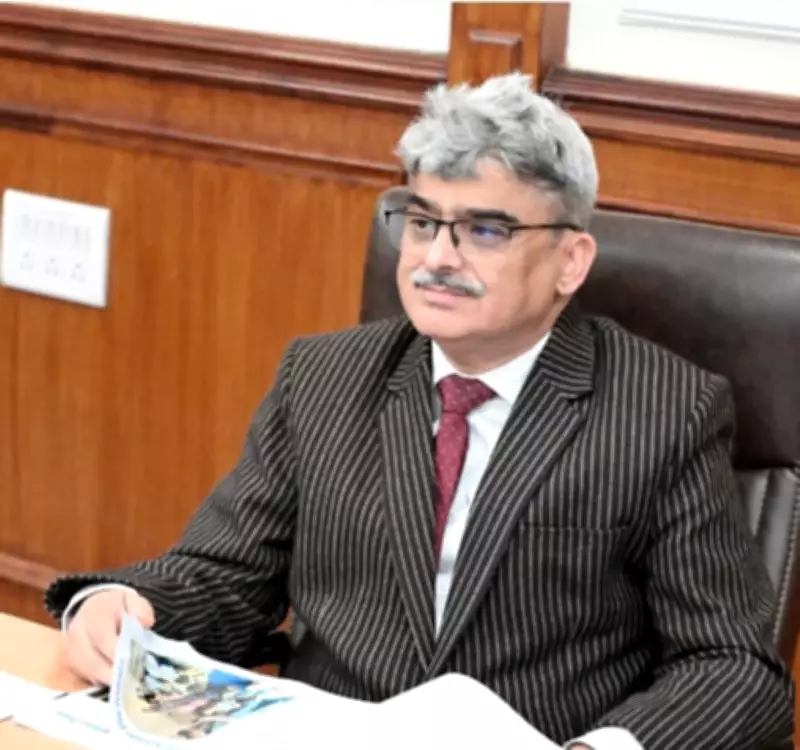
J&K Chief Secretary Reviews Land Records Digitisation Initiatives
Jammu and Kashmir Chief Secretary Atal Dulloo chaired a comprehensive review meeting on Sunday to assess key land records digitisation initiatives across the Union Territory. The meeting focused on programmes such as the Digital India Land Records Modernisation Programme (DILRMP), SVAMITVA Scheme, Unique Land Parcel Identification Number (ULPIN), and the National Geospatial Knowledge-based Land Survey of Urban Habitations (NAKSHA).
High-Level Attendance and Emphasis on Digital Transformation
The meeting was attended by Additional Chief Secretary Shaleen Kabra, Secretary Revenue Kumar Rajeev Ranjan, divisional commissioners of Jammu and Kashmir divisions, and deputy commissioners who joined via video conferencing from their respective district headquarters. Dulloo highlighted the transformative potential of these initiatives, drawing parallels with some of India's most successful digital programmes.
"These initiatives will revolutionise governance just like the success of Unified Payments Interface and other ambitious programmes such as Agristack. We are witnessing a technological revolution and Jammu and Kashmir must be an active participant in it," he stated.Emphasising the public benefits, Dulloo noted that a large number of public grievances are related to land issues, many of which will be resolved upon completion of the digitisation process. "This will greatly benefit the public by providing convenience and opening new avenues for development and governance," he added.

Progress and Achievements in Digitisation Efforts
Presenting the progress under DILRMP, Secretary Revenue Kumar Rajeev Ranjan reported that 98% of Khasras across the Union Territory have been digitised and approved, while 97% of villages have completed the first-level freezing process. He detailed that over 5,401 grievance camps have been organised at the village level for public reading of Jamabandis, recording more than 52,000 non-quasi judicial and over 5,700 quasi-judicial grievances, which are being addressed. Final freezing of the updated Jamabandis for 2026 is targeted for completion by March 31.
Regarding ULPIN, also known as Bhu-Aadhar, the meeting was informed that over 20.56 lakh Unique Land Parcel Identification Numbers have been generated for 3,320 villages so far. Under the digitisation of cadastral maps, 6,518 out of 6,857 villages—approximately 95.2%—have been geo-referenced.
Officials also reported that around 7.28 crore revenue documents, including Jamabandis, mutations, and Girdawari records, have been scanned and uploaded on the Land Records Information System (LRIS). Work under the NAKSHA programme for creating land records in urban habitations is progressing, with aerial survey, ORI generation, and ground-truthing completed for Bishnah.
Quality Assurance and Future Readiness
Speaking at the meeting, Additional Chief Secretary (Financial Commissioner, Revenue) Shaleen Kabra emphasised that land records digitisation will significantly improve accessibility, accuracy, and reliability of records, reducing disputes and strengthening public trust in the revenue administration. He stressed the need for rigorous quality checks at every stage to ensure that digitised records remain error-free and authentic.
Kabra urged revenue officials to exercise due diligence so that the exercise results in a reliable and future-ready land records management system. This focus on quality aims to build a robust framework that supports long-term governance and development goals in Jammu and Kashmir.