

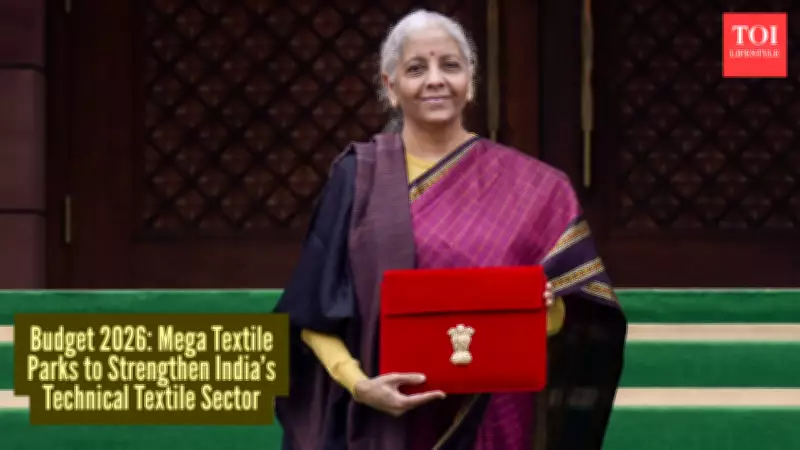
Sunday, February 1 represents far more than just another date on the calendar across India. This significant day marks the annual presentation of the Union Budget, a pivotal event that captures the nation's collective attention as it outlines financial priorities, economic projections, and strategic allocations for the forthcoming fiscal year. The budget essentially establishes the foundational framework for national development, determining which sectors receive crucial support, identifying growth areas, and revealing the government's economic vision and trajectory.
Textile Sector Emerges as Primary Focus
Budget 2026 has placed the textiles industry and small businesses directly under the spotlight with a series of targeted initiatives. Finance Minister Nirmala Sitharaman introduced a comprehensive package of measures specifically designed to stimulate employment generation, enhance export capabilities, and increase the global value of domestically manufactured products. The underlying message was unmistakably clear: textiles have been reinstated as a top-tier priority within the government's economic agenda.
Mega Textile Parks and Technical Textiles Initiative
One of the most significant announcements involved the establishment of mega textile parks with particular emphasis on technical textiles. These proposed facilities are envisioned as large-scale, fully-equipped industrial zones where companies can expand operations without encountering traditional infrastructural and regulatory obstacles. The fundamental rationale behind this approach is straightforward: achieving greater scale leads to reduced production costs, which in turn attracts increased investment. Rather than maintaining fragmented schemes that operate independently, the government aims to consolidate efforts under a unified framework to create a more coherent and efficient ecosystem.

Comprehensive Support for MSMEs and Traditional Industries
The budget extended its focus beyond large-scale industrial projects to address the needs of smaller enterprises and traditional sectors. A notable initiative involves the revitalization of approximately 200 older industrial clusters nationwide. These regions, which once flourished as manufacturing hubs, have gradually declined over time. The proposed intervention seeks to modernize these clusters with updated technology and market adaptation strategies while preserving their unique historical and cultural characteristics.
Financial Boost and Artisan Support Programs
In a substantial financial commitment, the Self-Reliant India Fund will receive an additional infusion of ₹4,000 crore during FY27. For countless micro, small, and medium enterprises (MSMEs), this enhanced access to capital could represent the crucial difference between mere survival and sustainable expansion. Simultaneously, traditional crafts received dedicated attention through the Mahatma Gandhi Gram Swaraj Initiative, which aims to elevate village-level economic activities, particularly benefiting khadi and handloom artisans. Complementary schemes focusing on natural fibers, textile employment, and handicraft preservation underscore a dual objective: safeguarding ancient skills in an rapidly evolving global marketplace while ensuring practitioners can maintain viable livelihoods.
Sustainability and Export Enhancement Measures
Budget 2026 incorporated environmental considerations through the Textile-Eco Initiative, designed to help Indian textile manufacturers comply with increasingly stringent international sustainability standards. This program encompasses improved training protocols, strengthened collaborations with academic institutions and fashion schools, and modernization of production methodologies. The overarching goal is maintaining competitiveness in markets that increasingly prioritize ethical and environmentally responsible manufacturing practices.

Export Policy Reforms for Key Industries
Export-oriented industries received substantial regulatory relief through an extension of the export obligation period from six months to twelve months for specific sectors including footwear, garments, leather goods, and marine exports utilizing duty-free imported inputs. This expanded timeframe alleviates operational pressure, simplifies compliance requirements, and improves cash flow management during periods of constrained profit margins.
Collectively, Budget 2026 represents a strategic wager on the synergistic potential of textiles, traditional craftsmanship, and small business vitality. The underlying philosophy suggests that strengthening foundational elements—from rural artisan communities to advanced manufacturing facilities—will naturally catalyze broader economic growth and development across the nation.





