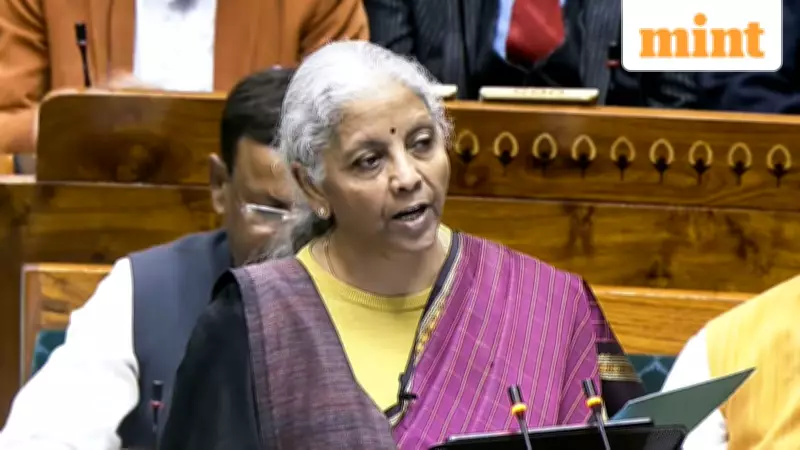
Finance Minister Nirmala Sitharaman, during her Union Budget 2026 speech on Sunday, announced a sustained and aggressive infrastructure push, with particular emphasis on cities boasting populations exceeding five lakh. Declaring that Tier 2 and Tier 3 cities have expanded to become significant "growth centres" for the nation, the FM underscored the government's commitment to fueling this expansion.
Massive Capex Growth and Future Allocation
Highlighting the transformative journey of public capital expenditure, Sitharaman noted that it has grown "manifold" from a modest ₹2 lakh crore in the fiscal year 2014-15 to an impressive ₹11.2 lakh crore in the Budget Estimates for 2025-26. To "continue the momentum" of this infrastructure revolution, she proposed a further increase, earmarking a substantial ₹12.2 lakh crore for public capex in the fiscal year 2026-27.
Boosting Private Sector Confidence
Recognizing the critical role of private investment, the Finance Minister introduced measures to strengthen developer confidence. A key proposal was the establishment of an Infrastructure Risk Guarantee Fund. This fund is designed to provide prudentially calibrated partial credit guarantees to lenders, thereby de-risking projects and encouraging greater private sector participation in the national infrastructure agenda.

Furthermore, to unlock value from public assets, Sitharaman added, "I propose to accelerate recycling of significant real-estate assets of the CPSEs through the setting up of dedicated rights." This move aims to generate additional resources for fresh infrastructure development.
Major Connectivity and Logistics Projects
The infrastructure blueprint outlined in the budget is comprehensive, targeting multi-modal connectivity:
- Dedicated Freight Corridors: Announcement of new corridors connecting Dankuni in the east to Surat in the west.
- Waterways Expansion: A plan to operationalize 20 new waterways over the next five years.
- Manpower Development: Establishment of training institutes as regional centres of excellence to develop the skilled workforce required for these new waterways. "This will benefit youth in the entire stretch of the waterways to train and acquire skills," Sitharaman stated.
- Ship Repair Ecosystem: Setting up of ship repair facilities at Varanasi and Patna to service vessels on both new and existing inland waterways.
Promoting Coastal and Niche Transport
The budget also introduced innovative schemes to enhance India's logistics efficiency and tourism potential:
- Coastal Cargo Promotion Scheme: A new initiative to incentivize a modal shift, aiming to increase the share of inland waterways and coastal shipping from the current 6% to 12% by the year 2047.
- Indigenous Sea Plane Manufacturing: A proposal to incentivize the domestic manufacturing of sea planes. This aims to promote last-mile connectivity in remote areas and boost tourism.
Strengthening Domestic Manufacturing for Infrastructure
To create a self-reliant ecosystem supporting this infrastructure surge, FM Sitharaman announced, "A scheme for enhancement of construction and infrastructure equipment will be introduced to strengthen domestic manufacturing of high-value, technology-advanced CIE." This scheme will cover a wide range of equipment, from firefighting systems and lifts to sophisticated tunnel boring machines, ensuring that the infrastructure build-out also fuels advanced manufacturing within the country.