

Vadodara Municipal Corporation Establishes Landmark Debt Management Framework
The Vadodara Municipal Corporation (VMC) has achieved a significant milestone by becoming the first civic body in India to formally institute a comprehensive debt management policy (DMP). This pioneering framework, developed with expert guidance from the United States Treasury Department, establishes clear regulations governing when and how VMC can issue debt instruments or secure advances.
Driving Factors Behind the Policy Implementation
The introduction of this policy comes at a critical juncture as VMC's capital expenditure has escalated substantially due to a growing portfolio of development projects. Many of these initiatives require matching contributions from the municipal corporation under various government schemes. To fulfill these financial obligations, VMC has increasingly turned to bonds and advances as primary funding mechanisms.
This strategic move aligns with the broader Smart Cities Mission framework, where the Union Ministry of Housing and Urban Affairs has established a collaborative arrangement with the US Treasury Department. This partnership provides technical assistance to six selected Indian cities for issuing municipal bonds, with Vadodara joining Rajkot, Pimpri Chinchwad, Faridabad, Mysore, and Mangaluru as beneficiaries of this international expertise exchange.

Current Financial Position and Future Projections
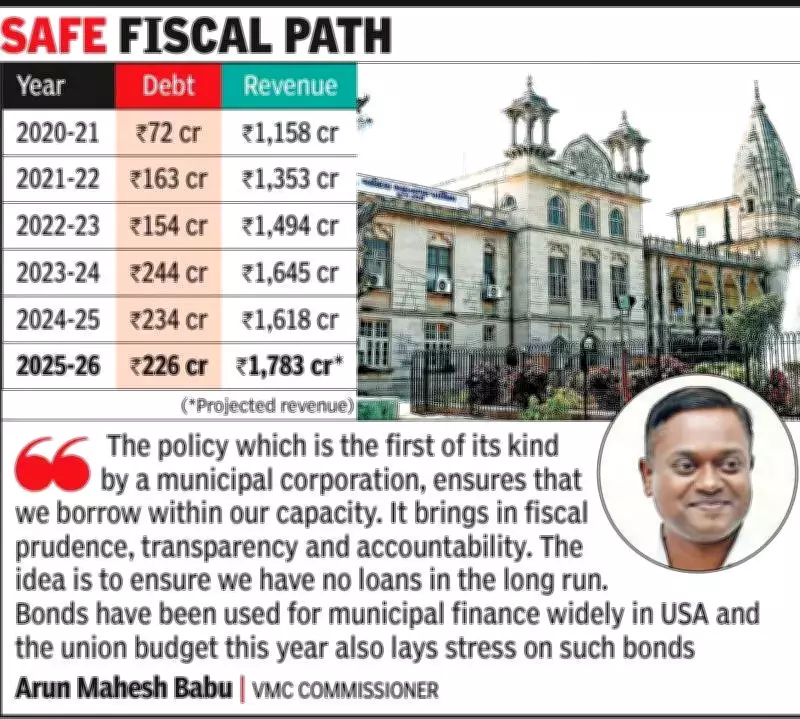
VMC's present borrowing portfolio stands at Rs 226 crore, comprising Rs 200 crore raised through bonds and Rs 26 crore in advances. Municipal officials emphasize that this debt exposure remains relatively low when measured against the corporation's substantial balance sheet size of Rs 16,817 crore.
Notably, VMC has demonstrated consistent fiscal improvement with debt levels declining over the past three fiscal years. The corporation projects revenue of Rs 1,783 crore for the current fiscal year, having recorded a surplus of Rs 430 crore as recently as February. Looking ahead, VMC plans to raise an additional Rs 200 crore through innovative Blue Bonds specifically earmarked for water supply schemes during the 2026-27 fiscal year.
The corporation has proactively established an escrow account containing Rs 120 crore dedicated exclusively to debt servicing, demonstrating prudent financial planning. Currently, approximately 4% of VMC's revenue is allocated toward debt repayment obligations.
Policy Framework and Safeguards
"This policy ensures debt is not taken recklessly," explained VMC Chief Account Officer Santosh Tiwari. "It creates a structured framework within which we can responsibly assume debt while establishing clear limits that cannot be crossed."
The comprehensive policy mandates several critical financial safeguards:
- Maintaining adequate operating surplus margins
- Sustaining sufficient cash reserves for contingencies
- Keeping leverage ratios low relative to revenue-generating resources like property tax
- Avoiding any actions that could potentially trigger credit rating downgrades
The policy explicitly restricts long-term debt usage exclusively to capital assets, infrastructure projects, and equipment acquisitions where costs can be reasonably distributed across multiple budget years. It strictly prohibits utilizing borrowed funds for routine annual operational expenses.
Implementation Protocols and Oversight Mechanisms
All bond issuances must be directly linked to clearly defined and formally approved projects with transparent objectives. The policy establishes that debt levels must never exceed limits determined through rigorous debt capacity analysis, which must be conducted at minimum annually, following the release of new financial results, and prior to any new debt issuance.
The policy itself incorporates a built-in review mechanism requiring annual updates and revisions to ensure continued relevance and effectiveness. A dedicated Debt Service Reserve Fund (DSRF) will be established, primarily funded through bond proceeds but potentially supplemented by municipal accounts or reallocated sinking fund deposits.

This reserve fund must be invested exclusively in safe, liquid assets and may be utilized specifically for making final debt service payments during the concluding year of a bond's tenure, providing an additional layer of financial security.
Political Endorsement and Governance Implications
VMC Standing Committee Chairman Sheetal Mistry emphasized the policy's role in strengthening fiscal discipline, stating, "The policy was formally ratified alongside the municipal budget and received full clearance from the elected governing wing, demonstrating cross-functional commitment to responsible financial management."
This groundbreaking policy positions Vadodara as a national leader in municipal financial governance, establishing a replicable model for other Indian cities seeking to balance ambitious infrastructure development with sustainable fiscal practices.





