Uttar Pradesh Government Launches Urban Redevelopment Policy 2026 to Combat Urban Decay
In a significant move to address urban decay and enhance safety, the Uttar Pradesh government officially notified the Urban Redevelopment Policy 2026 on February 10. This landmark policy establishes, for the first time, a comprehensive framework aimed at redeveloping unsafe and dilapidated buildings that have long posed risks to residents across the state.
Eligibility Criteria and Scope of the Policy
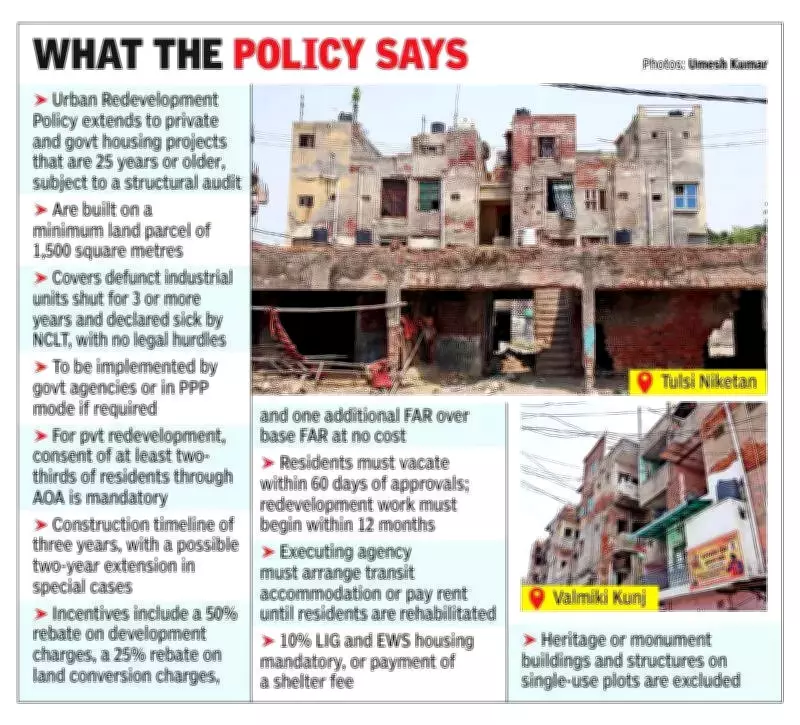
The policy targets both public and private housing projects that are at least 25 years old and cover an area of 1,500 square metres or more. A mandatory structural audit is required before any redevelopment can proceed. Additionally, defunct industrial units that have been shut for three years or more and declared sick by the National Company Law Tribunal, with no pending legal disputes, are also eligible for redevelopment under this new framework.
Implementation and Regulatory Clarity
Government agencies will serve as the primary implementing authorities, with provisions for execution under the public-private partnership (PPP) model where necessary. Officials highlighted that the policy addresses a longstanding regulatory vacuum that has stalled redevelopment efforts in various cities. "In the absence of clear-cut guidelines for redeveloping dilapidated buildings, development authorities, private developers, and apartment owners' associations were often unsure of the process, leading to prolonged delays. These delays not only endanger lives but also run counter to sustainable urban development," explained a senior official from the Ghaziabad Development Authority.

Addressing Land Scarcity and Housing Demand
The policy also aims to tackle land scarcity and the growing demand for housing by encouraging vertical redevelopment. Officials believe that underutilised land can be unlocked for additional residential units, including affordable housing. "Most ageing housing stock occupies large parcels of land. Redevelopment will allow more efficient use of space while adding much-needed affordable homes," the official added.
Key Provisions and Incentives
- For private redevelopment projects, apartment owners' associations must obtain consent from at least two-thirds of residents before proceeding.
- Construction timelines are capped at three years, with a possible extension of up to two years in special circumstances.
- To incentivise participation, the policy offers a 50% rebate on development charges and a 25% rebate on land conversion charges.
- Developers will be granted one additional floor area ratio (FAR) over the base FAR at no cost, allowing them to add more floors or flats to recover redevelopment costs.
Timelines and Responsibilities
The policy mandates that statutory formalities be completed within 60 days. Following this, residents of buildings identified for redevelopment must vacate the premises, and construction must begin within 12 months of vacation. The executing agency is responsible for arranging transit accommodation, including paying rent, until residents are handed back their flats after redevelopment.
Affordable Housing and Exclusions
At least 10% of the redeveloped units must be earmarked for economically weaker sections (EWS) and lower-income groups (LIG). However, developers have the option to pay a shelter fee in lieu of this requirement. The policy excludes declared monuments, heritage structures, and buildings constructed on single-use plots from its ambit.
Urgency in Cities Like Ghaziabad
The need for such a policy is particularly evident in cities like Ghaziabad, where a recent survey identified 150 buildings classified as "dangerous". The city has witnessed multiple fatalities from collapses of ageing structures, even as redevelopment efforts face persistent hurdles. For instance, the Ghaziabad Development Authority has encountered resistance in redeveloping older residential colonies such as Tulsi Niketan and Vaishali Apartment Scheme.

In Tulsi Niketan, approximately 2,300 flats built nearly four decades ago were declared unfit for habitation in 2018. Residents opposed redevelopment without written assurances of new flat allotments, largely due to ownership issues where 90% hold homes through power of attorney, while the Authority recognises ownership only via registered sale deeds. In December 2025, the NBCC was tasked with overseeing the colony's redevelopment.
Similarly, in 2018, three 10-storey towers in Vaishali Apartment Scheme were declared unsafe, with over 150 residents instructed to vacate. The redevelopment of these buildings remains pending to this day.
Expected Outcomes and Challenges
Officials expressed optimism that the new policy will provide clarity, accelerate stalled projects, and reduce disputes. However, they acknowledged that its success will ultimately depend on effective implementation and the confidence it inspires among residents, who have grown wary due to past delays and broken assurances.