

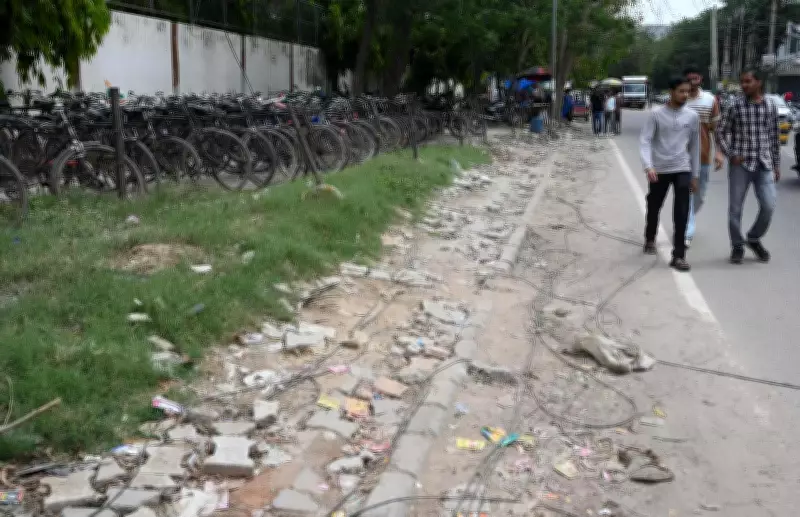
Gurgaon's Udyog Vihar Pedestrian Crisis: A Daily Struggle for Safety
Every evening, after finishing work in Udyog Vihar Phase 3, 26-year-old Nishi Mathur begins what should be a simple walk to the main road to catch an auto-rickshaw home. Instead, this short journey transforms into a hazardous trek through moving traffic, with no dedicated pedestrian space available. Forced to walk along the road edge, she navigates narrow shoulders, unpaved patches, and ramps, all while two-wheelers frequently use these same edges to bypass traffic, often brushing dangerously close to her. Even a mere 400-500 meter walk becomes a daily exercise in extreme caution and vigilance.
Widespread Ordeal in a Major Industrial Hub
Nishi Mathur is far from alone in this predicament. Thousands of employees in Udyog Vihar, one of Gurgaon's largest industrial and office hubs, endure the same ordeal each day. "There is no proper space to walk. I have to move between cars, bikes, and rickshaws. Sometimes I use the edge of the road or an unpaved patch, but even bikes come there. You keep dodging vehicles just to cross 400-500 meters to reach the main road," she explained. Despite heavy daily footfall, pedestrian infrastructure remains severely inadequate, compelling people to share road space with fast-moving vehicles. For a hub housing nearly 2,500 factories and offices, Udyog Vihar continues to be designed predominantly for vehicles, with minimal consideration for those on foot.
Most stretches in the area lack dedicated pedestrian facilities. Where footpaths do exist, they are often encroached upon by vendors, blocked by parked vehicles, or left in poor condition. In several areas, even road edges that could have served as walking space have been taken over for parking by employees of nearby factories and offices. The problem intensifies during peak hours when office dispersal coincides with heavy traffic movement. "The situation worsens during the monsoon. Waterlogging and potholes leave no safe edge to walk on. Both vehicles and pedestrians are left struggling for space," said Arjun Lal, an IT professional working in Udyog Vihar Phase 4.

Impact on Traffic and Daily Life
The lack of pedestrian infrastructure not only endangers those on foot but also significantly slows traffic movement. With no clear segregation, vehicles frequently halt or slow down to avoid pedestrians walking on the carriageway, exacerbating congestion. Even during the day, particularly in the afternoon, large numbers of people can be observed walking along roads during lunch breaks, underscoring the constant and urgent demand for safe walking spaces. "The issue is both road conditions and encroachments. Footpaths, where they exist, are either occupied or poorly maintained, and in many places, they don't exist at all. There is a need to build proper sidewalks, keep them free of encroachments, and create designated vending spaces so that both pedestrians and vehicles can move smoothly," emphasized Praveen Yadav, president of the Gurgaon Udyog Association.
Root Causes and Expert Insights
Experts highlight that the pedestrian space crisis in Udyog Vihar is closely linked to unregulated on-street parking and outdated infrastructure planning. "Most internal roads in Udyog Vihar are narrow and were never designed to handle the current volume of traffic and footfall. The biggest issue is that footpaths and road edges have effectively turned into parking spaces because industries and offices have not provided adequate parking within their premises. This is an old industrial area, and buildings need retrofitting to create in-house parking solutions. Unless on-street parking is strictly removed, pedestrian infrastructure cannot improve," explained Sarika Panda Bhatt, founder of the Raahgiri Foundation.

She added, "At the same time, footpaths need to be redeveloped with proper planning, ensuring they remain obstruction-free and integrated with drainage and other services. Without coordinated planning and changes in building norms, simply constructing footpaths will not solve the problem." According to the Haryana State Industrial and Infrastructure Development Corporation (HSIIDC), on-street parking in Udyog Vihar is not permitted, and there is no system allowing individuals or offices to use road space for parking independently. Only designated parking areas are permitted through a formal process with applicable charges.
Enforcement Challenges and Ongoing Efforts
Despite these regulations, vehicles are routinely parked along roadsides and on footpaths, especially in internal lanes, further reducing the already limited space. An HSIIDC senior official noted, "On-street parking is not formally allowed, but unauthorized parking continues in many stretches, including on footpaths and road edges. Enforcement is carried out by the traffic police, who issue challans and take action when violations are found. But given the nature of the area and the high demand for parking, the problem persists." The official added that efforts are being made to address the issue, with footpaths being constructed based on demand and priority to improve pedestrian safety.
This persistent crisis in Udyog Vihar highlights a critical need for comprehensive urban planning and stricter enforcement to ensure the safety and convenience of thousands of daily commuters.





