

Tamil Nadu Unveils Comprehensive 2030 Vision Document Based on Public Feedback
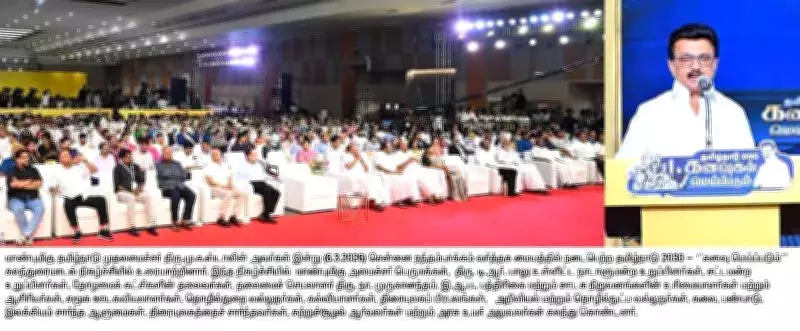
In a significant move, the Tamil Nadu government has officially launched its ambitious Tamil Nadu 2030 vision, a detailed roadmap crafted after gathering extensive feedback from an impressive 1.81 crore families across the state. This massive public consultation was conducted through the innovative "Ungal Kanavugalai Sollungal" survey, which translates to "Tell Your Dreams" in English. The vision lays out precise, sector-wise targets aimed at transforming housing, health, education, agriculture, and infrastructure over the next decade.
Education Sector Aims for Zero Dropouts and Smart Classrooms
The education component of the vision is particularly noteworthy. The government has set a bold goal to achieve zero school dropouts by 2030, ensuring every child completes their schooling. To modernize learning environments, the plan includes introducing smart classrooms in all government and aided schools, upgrading more than 300 libraries into advanced knowledge centres, and expanding skill training programs in colleges to significantly improve employability among graduates.
School Education Minister Anbil Mahesh Poyyamozhi highlighted a positive shift in student mindset, crediting Chief Minister M K Stalin for encouraging students to view sports as a viable career path. Additionally, the roadmap proposes establishing AI labs in higher educational institutions and implementing AI-enabled monitoring and intelligent transport systems on highways. These technological advancements are expected to enhance traffic management, extend the lifespan of roads, and reduce accidents, showcasing a forward-thinking approach to infrastructure.

Healthcare Initiatives Focus on Insurance and Mental Health
In the healthcare sector, Chief Minister Stalin emphasized that steps will be taken to ensure adequate medical insurance coverage for everyone in Tamil Nadu. The vision aims for the state to rank first in India in reducing infant and maternal mortality rates. Furthermore, mental health counselling centres will be established in every district, addressing a critical aspect of public health often overlooked.
Health Minister Ma Subramanian provided context by noting that his department received over 1,236 awards in the past five years, including recognition from the UN Inter-Agency Task Force and national quality certifications. He also revealed that more than 15 lakh people travelled to Tamil Nadu for healthcare during this period, underscoring the state's growing reputation in medical services.
Agricultural and Economic Targets for Growth
The agricultural vision sets ambitious targets: expanding cultivable area to 50 lakh hectares, increasing foodgrain production to 125 lakh tonnes, and extending micro-irrigation to 21 lakh hectares. The roadmap also aims to boost fisheries production, milk output, and livestock numbers, promoting sustainable farming practices.
On the economic front, the vision outlines goals to attract 18 lakh crore in investments, create 50 lakh jobs, and increase exports to $120 billion. Industries Minister T R B Raaja pointed out that the state has already created more than 36 lakh jobs in the past five years through 1,190 Memorandums of Understanding (MoUs), with a total proposed investment of 12.5 lakh crore, indicating strong progress toward these future targets.
Community Engagement and Special Schemes
Chief Minister Stalin announced the "Uttamar Gandhi Model Villages project", a scheme named in honor of Mahatma Gandhi, starting with 10 village panchayats. This initiative aims to transform villages into centres of economic activity by strengthening local infrastructure, rural employment, and community assets, reflecting a commitment to rural development.

Explaining the preparation process, Additional Chief Secretary P Amudha detailed that 50,000 volunteers were trained and a mobile app was developed to collect feedback under the Ungal Kanavugalai Sollungal survey. She noted that the survey revealed many families benefited from five to six government schemes, highlighting the impact of existing policies.
This comprehensive vision document represents a holistic approach to development, leveraging public input to set realistic and transformative goals for Tamil Nadu's future across multiple sectors.





