

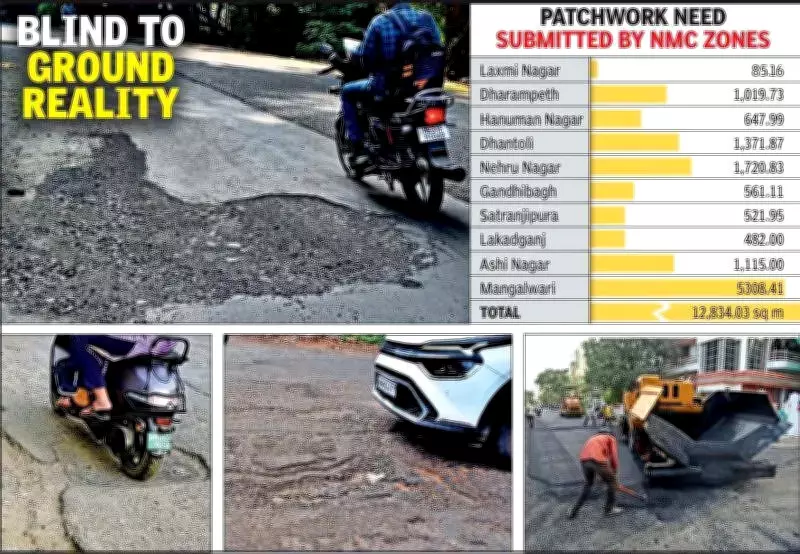
Nagpur's Pothole Paradox: Official Figures Show Minimal Repair Needs Despite Citizen Outcry
In a development that has left residents baffled, Nagpur's notorious pothole problem appears to have magically disappeared according to official municipal records. Data submitted by the Nagpur Municipal Corporation's 10 zonal offices indicates that a mere 12,834.03 square meters of asphalt roads across the entire city require patchwork repairs.
Contradiction Between Official Data and Ground Reality
This official claim stands in stark contrast to months of persistent complaints from motorists, residents, and daily commuters about severely damaged internal roads and crater-like potholes on multiple city stretches. Despite repeated instructions from NMC headquarters, zonal engineers have submitted what officials themselves describe as surprisingly "minimal" repair requirements, raising serious questions about the accuracy of ground-level assessments.
The executive engineer of NMC's hot-mix plant department has now issued a second reminder, directing all zonal executive engineers and assistant commissioners to submit revised road repair estimates within three days. The communication reveals that the current reported repair area could be completed by the plant in just 24 days, highlighting the remarkably small volume of work identified.

Glaring Inconsistencies in Zone-Wise Reporting
An analysis of the submitted figures reveals significant discrepancies between different zones:
- Nehru Nagar zone reported over 1,700 square meters requiring patchwork
- Dhantoli zone identified approximately 1,371 square meters needing repairs
- Dharampeth zone reported just over 1,000 square meters requiring attention
Several other zones, however, have submitted surprisingly low figures despite visible road damage and frequent complaints from local citizens. This inconsistency has prompted concerns about systematic underreporting of actual repair needs.
Monsoon Concerns and Historical Patterns
The NMC communication includes a significant warning that once the final proposal is approved with a 10% contingency allowance, no additional requests for annual road maintenance will be considered. This has triggered apprehension among civic observers that zonal officials might be deliberately underreporting current patchwork requirements only to push for emergency repairs during the upcoming monsoon season.
This pattern mirrors previous years' experiences where minimal pre-monsoon repair estimates were followed by urgent monsoon-related repair requests, suggesting a recurring systemic issue in Nagpur's road maintenance approach.
Chronic Underutilization of Municipal Infrastructure
The situation highlights the persistent underutilization of NMC's upgraded in-house hot-mix plant facility. This infrastructure was specifically strengthened to accelerate pothole repairs and reduce dependence on private contractors. However, the latest figures indicate that zonal offices remain reluctant to fully utilize this municipal resource, raising questions about implementation efficiency.
Complex Road Ownership Challenges
Nagpur's road network presents a complex ownership landscape with multiple agencies involved:
- Nagpur Municipal Corporation owns over 4,000 kilometers of roads
- Nagpur Improvement Trust manages additional road sections
- State Public Works Department oversees certain major roads
- National Highways Authority of India controls national highway segments
- Maha Metro is responsible for roads in its operational areas
Experts note that, with the exception of NMC, most agencies fail to adequately maintain roads under their jurisdiction. Urban planning specialists argue that a single agency should be made responsible for maintaining all city roads within municipal corporation limits to ensure accountability and consistent maintenance standards.
The current discrepancy between official repair estimates and citizen experiences underscores deeper systemic issues in Nagpur's urban infrastructure management, calling for more transparent assessment mechanisms and coordinated maintenance approaches across all responsible agencies.






