

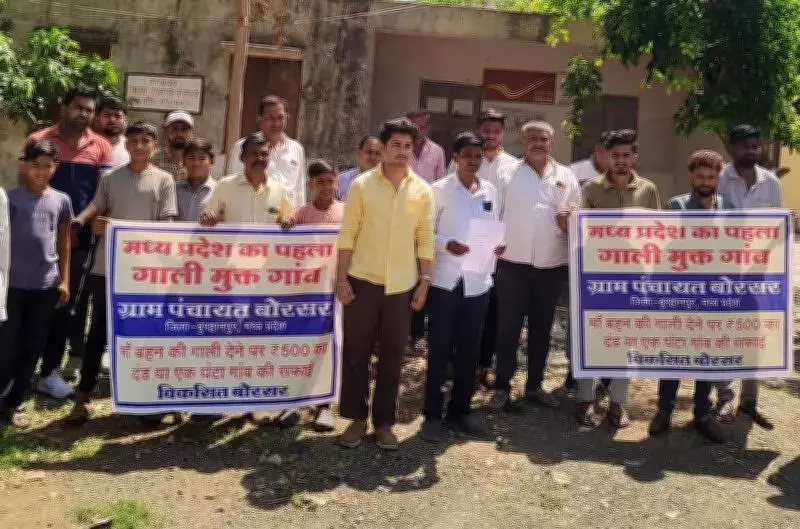
Madhya Pradesh Village Imposes Strict Penalties for Swear Words
In a unique civic initiative, Borsar village in Madhya Pradesh's Burhanpur district has implemented a strict rule against using abusive language. Residents who utter swear words now face a penalty of Rs 500 or, alternatively, are required to sweep the village streets for one hour as punishment.
Transforming Public Discourse Through Community Action
Located approximately 20 kilometers from the district headquarters, this village of nearly 6,000 residents has turned civility into both a local etiquette and a community mission. The rule was introduced by sarpanch Antar Singh, deputy sarpanch Vinod Shinde, and social worker Ashwin Patil with a simple message: mind your language or clean the streets.
The impact on public discourse has been significant. Locals and even outsiders now think twice before letting expletives fly. "Children as young as 12–13 years had started using abusive language openly. We witnessed two to three serious disputes recently where people openly mouthed swear words targeting mothers and sisters. One person would abuse, the other would retaliate in kind. It just kept getting worse," explained sarpanch Antar Singh to TOI. "We felt the need to step in and put an end to this."

Visible Changes and Community Support
The change is already noticeable on the ground. "Earlier, people would hurl abuses casually at crossroads. Now they hesitate and think before speaking. There is a sense of fear. Women in the village are happy — it is a positive change," Singh added.
The idea originated from Ashwin Patil, a 29-year-old social worker who returned to the village after spending nearly a decade in Mumbai working as a small-time actor. "There was just too much verbal abuse flying around, vitiating the ambience around us. I presented the idea to the sarpanch and the deputy sarpanch, and they immediately supported it," Patil told TOI.
Structured Implementation and Decentralized Monitoring
Instead of limiting the initiative to a random public announcement, the panchayat formalized it into a structured regulation. Posters were displayed across the village, and residents collectively pledged to maintain clean language. Monitoring was decentralized, with more than 20 ward members entrusted with overseeing public speaking, particularly at intersections where locals typically gather.
If someone is caught violating the no-slang rule, the panchayat issues an immediate notice. The initiative has also engaged elders and residents, transforming it into a shared responsibility rather than top-down enforcement. "Villagers themselves are stepping forward. Senior members are also keeping an eye and guiding people," Patil noted.
Part of Broader Civic Improvement Efforts
The language reform is part of a broader push to enhance civic life in Borsar village. Over the past three months, multiple initiatives have been launched:
- A cleanliness drive with dustbins installed across various areas
- Plantation activities under a ‘har ghar hariyali’ campaign
- Free Wi-Fi access at key public squares using QR-based login systems
Additionally, to foster collective responsibility, the national anthem is played every morning at 8:30 AM through temple speakers, prompting residents to pause their work and stand in respect—a practice that has continued for two months.
Another community-support initiative is a ‘seva room’, where those who can afford it leave essential items for the needy to collect without hesitation.
Discipline Enforced with Practical Measures
Back on the streets, the most striking change is the silence replacing abuses. In Borsar, discipline is no longer merely advised; it is practiced, monitored, and, when necessary, enforced with a broom. This innovative approach demonstrates how local governance and community participation can effectively address social issues and improve public behavior.






