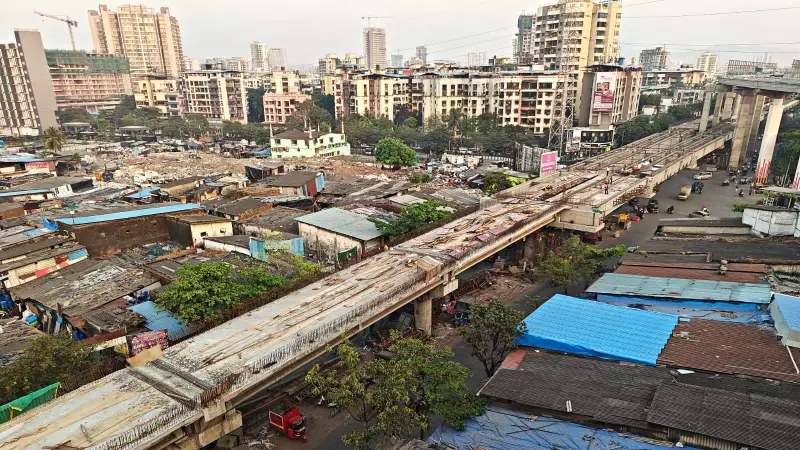
Mira Bhayandar Flyover's Abrupt Lane Narrowing Sparks Safety Concerns
A newly constructed flyover in Mira Bhayandar has drawn significant criticism and raised serious safety concerns due to its abrupt narrowing from four lanes to two lanes. This design feature has sparked public debate and questions about the planning behind this infrastructure project.
What the Flyover Is Part Of
The flyover runs along the soon-to-be-inaugurated Metro Line 9, connecting Mira Bhayandar Road with Golden Nest Circle in Bhayandar. This junction is one of the busiest in the area, where five roads converge, resulting in heavy traffic throughout the day. According to the Mumbai Metropolitan Region Development Authority (MMRDA), the flyover aims to reduce congestion on Mira Bhayandar Road by providing a grade-separated route for vehicles traveling toward Bhayandar.
Local residents have strongly questioned the design, particularly pointing out that the flyover narrows sharply as it merges under Metro Line 9 near the Shaheed Bhagat Singh Garden station. This sudden transition has led to worries about potential traffic bottlenecks and safety hazards.

MMRDA's Response to Design Concerns
In response to a viral video highlighting the issue, MMRDA clarified that the lane transition was intentional and based on physical constraints at the site. The authority stated in a post on X that "the transition is based on available road width constraints and future network planning." They explained that the descending ramps have been kept at two lanes because the right of way on the road below reduces near Railway Phatak Road. According to MMRDA, narrowing the ramp helps maintain smoother traffic movement at ground level.
Why the Flyover Changes from Four Lanes to Two
MMRDA elaborated that the flyover follows a two-plus-two lane pattern near Golden Nest Circle, where traffic from multiple directions converges. The structure then splits, with two lanes designated for Bhayandar East and two lanes planned for future extension toward Bhayandar West. "Since the Bhayandar East arm comes first along the alignment, the four-lane configuration presently transitions into two lanes. The remaining two lanes on the outer side are planned as part of the future extension towards Bhayandar West across the Western Railway line," the authority explained. Currently, only the Bhayandar East arm will be operational.
Plans for Future Widening
MMRDA emphasized that the flyover has been designed with scope for expansion at a later stage. They noted that one additional lane on each side can be built in the future to improve east-west connectivity. "Provision has been kept for future widening, wherein the outer side of the flyover on both carriageways will be extended by an additional one-plus-one lane to ensure improved east-west traffic continuity," the authority stated. However, this proposal remains at the planning stage and will require coordination with the Mira Bhayandar Municipal Corporation and approval from competent authorities.
Safety Measures on the Flyover
To address safety concerns, MMRDA highlighted that multiple safety features have been incorporated into the structure to guide drivers through the changing lane pattern and reduce accident risks. These include:
- Rumble strips
- Lane markers
- Signage
- Retro-reflective tags
- Directional boards
- Crash barriers
What Happens Next
The flyover is expected to open alongside Metro Line 9 and is projected to play a crucial role in easing congestion on the Mira Bhayandar Road corridor. However, the unusual lane transition has underscored the challenges of integrating large transport projects into densely built urban areas. Whether this design functions smoothly in practice will only become apparent after the flyover opens to traffic. For now, MMRDA maintains that the layout is part of a phased plan, with future extensions intended to address the concerns raised by local residents.