Kerala Groundwater Census Maps 22 Lakh Wells in Pioneering Water Security Initiative
In a landmark move for water resource management in India, the groundwater department of Kerala has successfully completed the first phase of a comprehensive statewide well census. This pioneering initiative has involved the meticulous counting and mapping of an impressive 22 lakh wells, which include tube wells and borewells, across 563 panchayats.
Developing a Data-Driven Water-Budgeting Framework
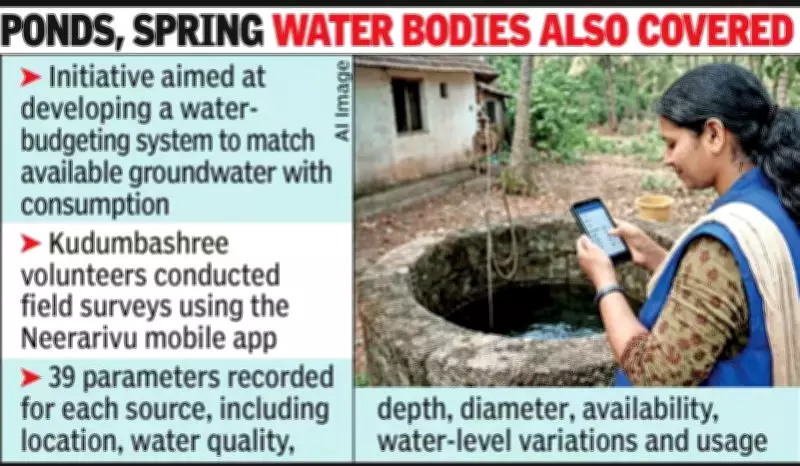
The primary objective of this extensive survey is to establish a robust water-budgeting system. This innovative, data-driven framework is designed to accurately assess available water resources and balance them against current and projected consumption patterns. By creating this detailed inventory, authorities aim to move towards more scientific and sustainable groundwater management.
Of the total panchayats covered in this initial phase, the census has been fully completed in 331 panchayats. In the remaining 232 panchayats, approximately 70% of the work has been finalized. Active steps are currently underway to complete data collection in the remaining 59 blocks by incorporating the exercise under the state plan fund. The subsequent phase of this ambitious program is scheduled to commence in the next financial year.

Collaborative Data Collection with Kudumbashree Volunteers
The survey was executed through a collaborative effort involving specially trained Kudumbashree volunteers. These volunteers played a crucial role in collecting and uploading field data using a dedicated mobile application named Neerarivu. This grassroots approach ensured widespread coverage and local accuracy in data gathering.
Officials recorded a comprehensive set of 39 distinct parameters for each identified water source. Key data points included the precise location of the well, detailed water quality assessments, depth measurements, diameter specifications, and patterns of water availability and usage. The survey also meticulously documented water-level variations over time.
Comprehensive Environmental and Usage Documentation
Beyond basic well characteristics, the census captured critical environmental factors. These included the distance from potential contamination sources such as septic tanks and cattle sheds, as well as detailed analysis of the soil composition surrounding each well. In addition to traditional wells, the mapping process also encompassed ponds and spring water bodies, providing a holistic view of the state's water resources.
Lal Thompson, the superintending hydrogeologist and nodal officer of the national hydrology project, emphasized the critical importance of this initiative. He stated that gathering accurate, granular information on groundwater abstraction structures—including traditional open wells, tube wells, borewells, and ponds—is fundamental to ensuring long-term water security for the state.
Strategic Applications for Drought Management and Planning
Thompson further explained that the data collected will serve as a vital foundation for drought forecasting and mitigation planning. It will enable the preparation of detailed, locality-specific groundwater budgeting plans. Once fully compiled and analyzed, the project will deliver a significantly clearer understanding of Kerala's groundwater reserves.
The insights generated are expected to help authorities identify drought-prone regions with greater precision, guide the design of scientifically sound groundwater recharge schemes, and assist in planning effective drought-preparedness measures. A key public health benefit will be ensuring the availability of safe drinking water and reducing the incidence of water-borne diseases.

Creating a Digital Database for Future Monitoring
This initiative will culminate in the creation of a comprehensive digital database of water sources. This repository will empower authorities to monitor and maintain traditional open wells, which are recognized for their crucial role in natural groundwater recharge. However, the survey also highlights a concerning trend: many such wells and traditional water bodies are now abandoned and are increasingly being misused as dumping sites.
Addressing Kerala's Water Dependency and Challenges
Kerala's economy and daily life are heavily dependent on groundwater for domestic, agricultural, and industrial needs. The state faces significant challenges, including the growing prevalence of pit latrines in both urban and rural areas, which pose serious risks to water quality through contamination.
Simultaneously, there is an increasing reliance on borewells, often driven by the declining water quality in traditional open wells. This shift is placing additional, unsustainable pressure on already strained groundwater resources. The data from this census is poised to strengthen groundwater management protocols and enable better regulation of extraction, addressing a critical gap where such activities have often gone unmonitored.