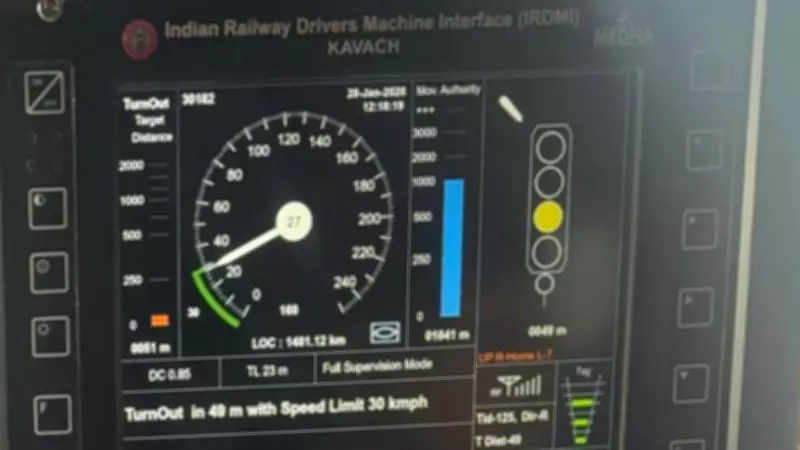
Indian Railways Commissions Kavach 4.0 on 455 Route Kilometers to Boost Rail Safety
In a significant move to enhance passenger safety and operational reliability, the Ministry of Railways has commissioned the indigenously developed Kavach 4.0 automatic train protection (ATP) system across 455 route kilometers (RKm). This deployment marks a crucial step in modernizing India's rail infrastructure with cutting-edge safety technology.
Strategic Deployment Across Key Railway Sections
According to Dilip Kumar, Executive Director (Information & Publicity) at the Railway Board, the Kavach 4.0 system has been strategically implemented across three major sections:
- Virar–Surat section (Western Railway): Covering 333 RKm, this installation includes 28 stations and 28 block sections. The project involved deploying 33 S-Kavach units, 64 Radio Interface Units (RIUs), erecting 33 tubular lattice towers of 40-meter height, and laying 412 km of optical fiber cable in dual paths.
- Tughlakabad Junction cabin–Palwal section (Northern Railway): Spanning 34 RKm, this four-line corridor covers 152 main-line track kilometers with major station yards. The system has been installed across all lines, including those with automatic signaling and absolute block signaling systems.
- MPO–SNND section (East Central Railway): Covering 88 RKm on the Manpur-Sarmatand section of the DDU-Pradhankhanta rail line, this crucial part of the busy Delhi-Howrah corridor passes through Uttar Pradesh, Bihar, and Jharkhand. It serves 77 stations, including 8 junctions, 79 level crossing gates, and handles mixed traffic including freight, mail/express, and passenger trains.
How Kavach 4.0 Enhances Rail Safety
The Kavach system represents a technological leap in Indian railway safety by automatically applying brakes in critical situations. Its comprehensive safety features include:

- Prevention of Signal Passing at Danger (SPAD): Automatically stops trains from passing signals at danger, reducing human error.
- Collision Avoidance: Protects against head-on and rear-end collisions through continuous monitoring and automatic intervention.
- Speed Control: Continuously monitors and controls overspeeding, ensuring trains operate within safe limits.
- Adverse Condition Safety: Maintains safety even in low visibility and challenging weather conditions.
- Global Safety Standards: Complies with SIL-4 safety standards, representing the highest level of safety integrity globally.
Indigenous Development and Strategic Importance
As an indigenously designed and cost-effective system, Kavach 4.0 significantly reduces dependence on imported technologies while promoting the growth of India's signaling industry. This deployment not only enhances passenger safety but also strengthens the reliability of train operations across the region, contributing to more efficient and secure rail transportation.
The system's implementation across these strategic corridors demonstrates Indian Railways' commitment to leveraging homegrown technology for critical infrastructure safety, setting a precedent for future rail modernization initiatives across the country.