

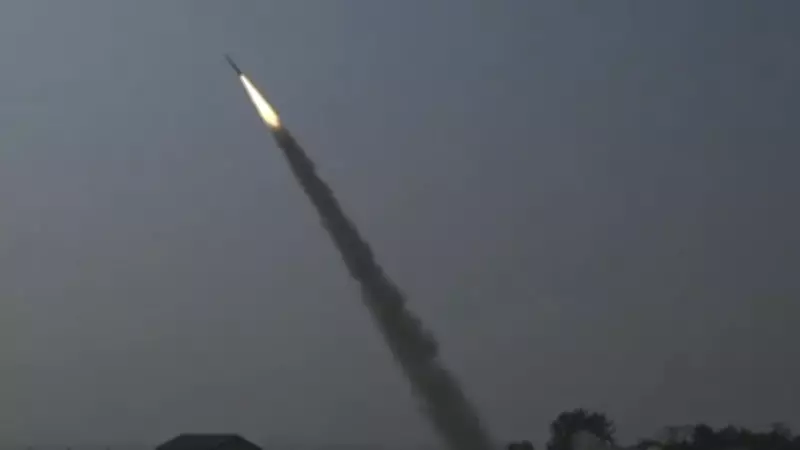
DRDO Achieves Breakthrough with Solid Fuel Ramjet Technology Test
The Defence Research and Development Organisation (DRDO) has marked a significant milestone with the successful demonstration of Solid Fuel Ducted Ramjet (SFDR) technology. This achievement propels India into an exclusive group of nations possessing this critical propulsion system, essential for developing long-range supersonic air-to-air missiles.
Successful Test Conducted from Odisha Coast
According to an official press statement from the Ministry of Defence, DRDO carried out the successful demonstration from the Integrated Test Range (ITR) at Chandipur, located off the coast of Odisha. The test occurred at approximately 10:45 AM on February 3, 2026, with all subsystems performing as expected.
The launch was monitored by senior scientists from various DRDO laboratories, including the Defence Research and Development Laboratory (DRDL) in Hyderabad, the High Energy Materials Research Laboratory (HEMRL) in Pune, and the Research Centre Imarat (RCI) in Hyderabad. Flight data was captured by multiple tracking instruments deployed along the Bay of Bengal coast, confirming the system's performance.

Advanced Propulsion System Explained
SFDR represents an advanced air-breathing propulsion system where a solid fuel gas generator produces fuel-rich gases. These gases mix with incoming air and burn in a ramjet combustor. Unlike conventional rockets, SFDR does not carry an oxidizer, making it lighter and more efficient for sustained high-speed flight.
The technology relies on the missile's high forward speed to compress incoming air, eliminating the need for a mechanical compressor. This ramjet approach enables efficient supersonic flight over extended ranges, with the system providing sustained thrust and allowing thrust modulation during flight.
Strategic Advantages and Development
The SFDR technology has been developed through collaboration between multiple DRDO laboratories:
- Defence Research and Development Laboratory (DRDL), Hyderabad - Lead development
- Research Centre Imarat (RCI), Hyderabad - Collaboration partner
- High Energy Materials Research Laboratory (HEMRL), Pune - Collaboration partner
This propulsion system offers several strategic advantages for missile development:
- Enables interception of aerial threats at very long ranges
- Maintains supersonic speeds throughout engagement
- Provides simpler, safer storage and transport compared to liquid fuel systems
- Offers sustained propulsion throughout much of the missile's flight
Official Recognition and Future Implications
Defence Minister Rajnath Singh and DRDO Chairman Dr. Samir V. Kamat have congratulated the various DRDO teams and industry partners on this successful demonstration. The technology represents a crucial advancement in India's defence capabilities, particularly for air-to-air missile systems that require extended range and high-speed performance.
The successful test demonstrates India's growing expertise in advanced propulsion technologies and strengthens the country's position in defence research and development. This achievement follows other recent DRDO successes, including the debut of hypersonic glide missile technology at the Republic Day parade.






