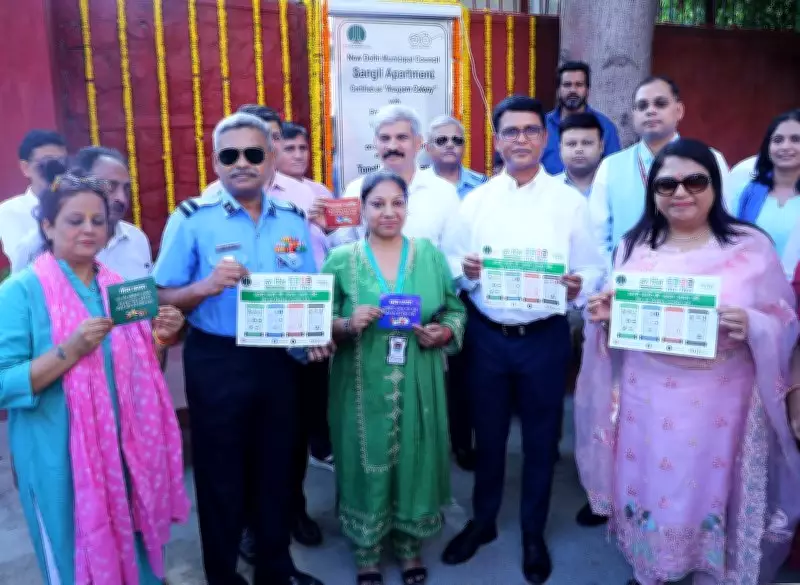
The New Delhi Municipal Council (NDMC) on Monday declared Sangli Apartments as an 'Anupam Colony', recognizing its residents' participation in waste management and sustainability efforts. This certification, launched in June 2025, is reserved for colonies that adopt a zero-waste approach to community living.
What is an Anupam Colony?
An 'Anupam Colony' is a sustainability certification given by the NDMC to residential colonies that have adopted advanced decentralised waste management practices. To qualify, neighbourhoods must ensure 100 per cent segregation of waste at source, process wet and horticultural waste within the colony, scientifically manage dry waste, and actively involve residents in sustainability initiatives.
Far from being a simple cleanliness award, the certification requires colonies to operate composting units, Material Recovery Facilities, Reduce-Reuse-Recycle (RRR) centres, and 'Neki Ki Deewar' donation walls that help extend the life of usable items.

Expanding the Movement
The initiative began in June 2025 when Chanakyapuri's D-1, D-2 and Satya Sadan Officers' Flats became the first colonies to receive the tag. Since then, Bharti Nagar, Aradhana Society, Bapu Dham, New Moti Bagh, Kaka Nagar, Jor Bagh, and most recently Sangli Apartments have joined the list, bringing the total to eight certified colonies.
Sangli Apartments on Copernicus Marg is also the first defence officers' residential colony to be recognised as an Anupam Colony, highlighting how the initiative is expanding across different kinds of communities.
Community-Driven Impact
What makes the model stand out is its emphasis on people rather than infrastructure alone. Residents are expected to become active participants in waste management rather than leaving the responsibility entirely to civic authorities. Many of these colonies now operate on-site composting and recycling systems, with mechanised, dust-free cleaning systems in place.
For the NDMC, the idea is to create neighbourhoods that generate minimal waste and reduce dependence on landfills. For residents, the benefits are often more immediate: cleaner surroundings, greener common spaces, and stronger community participation.
As Delhi searches for long-term solutions to its waste crisis, these eight colonies offer a glimpse of what sustainable urban living could look like. Their success suggests that tackling the city's waste problem may begin not at landfill sites, but inside homes, apartment complexes and neighbourhood communities where everyday habits can collectively make a significant difference.