

CAG Audit Uncovers Widespread Vehicle Compliance Failures in Gujarat
A recent report by the Comptroller and Auditor General (CAG) has exposed significant compliance gaps within Gujarat's transport administration, raising serious concerns about enforcement of emission norms and public health safeguards. The audit findings reveal systemic failures that have allowed millions of vehicles to operate without proper documentation and pollution checks.
Expired Pollution Certificates Affecting Millions of Vehicles
The most alarming revelation concerns Pollution Under Control Certificates (PUCC), with 39.13 lakh vehicles having expired certificates as of December 31, 2023, that remained unrenewed through March 2024. This represents a massive breach of environmental regulations designed to control vehicular emissions and protect public health.
Even more concerning is the finding that owners of 69,26,536 vehicles registered between April 1, 2009 and March 31, 2019 failed to renew their PUCC even once during the five-year period from April 2019 to March 2024. This indicates that a substantial portion of Gujarat's vehicle fleet may have operated for years without the periodic emission checks mandated under motor vehicle laws.

Registration and Fitness Certificate Violations
The compliance failures extend beyond pollution certificates. The audit identified that registration certificates of 5.4 lakh vehicles expired between April 2019 and March 2024, with owners neither renewing them nor reporting the vehicles as destroyed or incapacitated. This administrative gap has resulted in non-realization of potential renewal fees amounting to Rs 88.6 crore for the state exchequer.
Furthermore, 4.99 lakh vehicles — primarily transport and other specific category vehicles — were found operating with expired fitness certificates. This violation involves leviable fees and penalties totaling approximately Rs 980.2 crore, representing a significant revenue loss for the state government.
Safety and Technology Deficiencies
The CAG report highlights critical safety shortcomings, noting that mandatory safety and tracking features were missing from numerous vehicles. These deficiencies include:
- Absence of speed governors on vehicles requiring them
- Missing High Security Registration Plates
- Non-installation of vehicle tracking system devices
Toll booth data analysis confirmed that vehicles continued to operate despite these violations of motor vehicle laws, with administrative and technology-related lapses compounding the compliance problems.
Systemic Administrative Failures
The audit identified multiple systemic issues contributing to these widespread compliance failures:
- Incorrect vehicle categorization leading to improper fee assessment
- Delayed updates in Vahan and Sarathi database systems
- Weak application controls resulting in short levy of fees and tax losses
- Failure to link permit, fitness, and PUCC issuance with compliance checks and payment of dues
One particularly egregious example involved the issuance of 79,762 duplicate driving licences at the earlier fee of Rs 200 instead of the revised rate of Rs 400, costing the state exchequer approximately Rs 1.60 crore in lost revenue.
CAG Recommendations for Systemic Reform
The audit report warns that unless corrective action is taken, Gujarat risks continued revenue loss, rising pollution levels, and greater threats to road safety. To address these critical issues, the CAG has proposed several key recommendations:

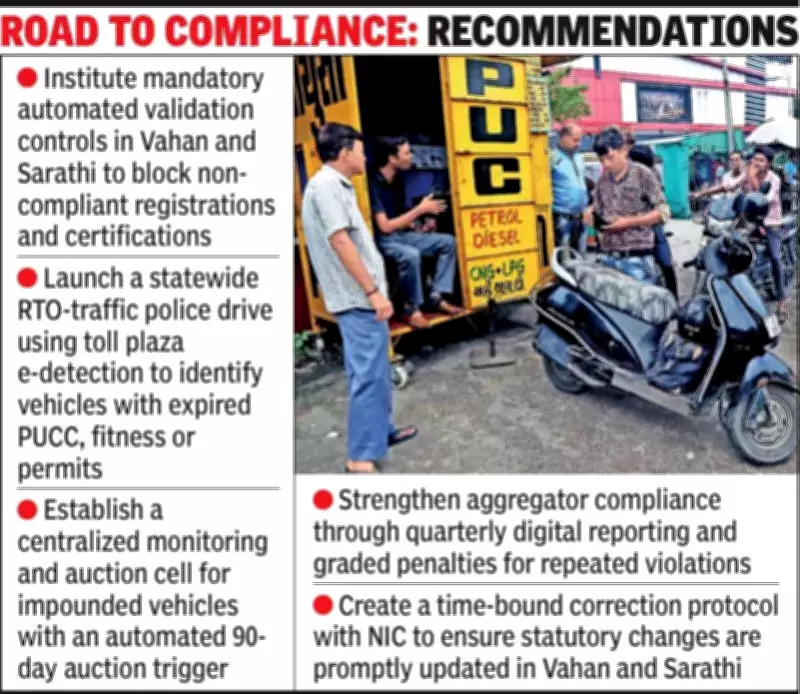
- Institute mandatory automated validation controls in Vahan and Sarathi systems to block non-compliant registrations and certifications
- Launch a statewide RTO-traffic police drive using toll plaza electronic detection to identify vehicles with expired PUCC, fitness certificates, or permits
- Establish a centralized monitoring and auction cell for impounded vehicles with an automated 90-day auction trigger mechanism
- Strengthen aggregator compliance through quarterly digital reporting and graded penalties for repeated violations
- Create a time-bound correction protocol with the National Informatics Centre (NIC) to ensure statutory changes are promptly updated in Vahan and Sarathi systems
The comprehensive audit findings underscore the urgent need for technological upgrades, administrative reforms, and stricter enforcement mechanisms within Gujarat's transport administration to ensure compliance with environmental regulations and road safety standards.





