

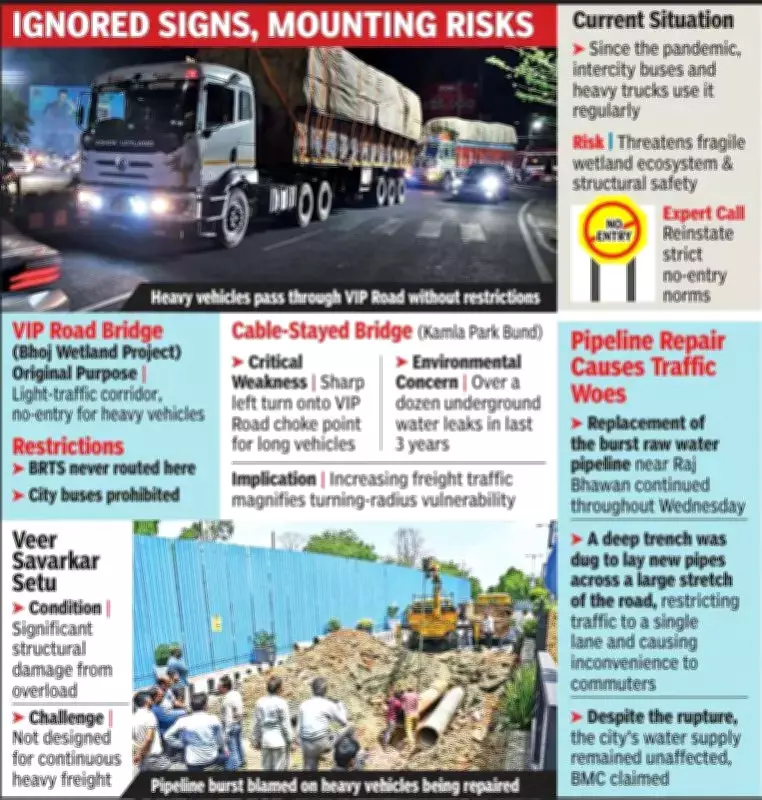
Bhopal's Urban Infrastructure Under Severe Strain from Heavy Freight Traffic
The urban roads and bridges of Bhopal are experiencing mounting and unsustainable stress as heavy freight traffic persistently navigates through the city center, bypassing designated alternative routes. This alarming trend poses significant risks to structural integrity and public safety, with engineers raising urgent red flags.
Design Limits Exceeded by Modern Heavy Vehicles
When many of Bhopal's critical bridges were constructed during the 1990s, they were engineered to accommodate vehicles with loads approximating 30 tons. However, the contemporary reality presents a stark and dangerous contrast. Today, it is increasingly common to witness trucks weighing between 80 and 150 tons traversing these same city roads, far surpassing the originally approved and safe load-bearing capacities. This substantial overload directly threatens the long-term viability and immediate safety of the infrastructure.
Growing Safety Concerns and Lessons from Past Tragedy
Concerns regarding bridge safety in Bhopal continue to escalate sharply. Experts are issuing stern warnings that critical maintenance lapses and vital lessons from previous infrastructure failures are being systematically overlooked. A poignant and tragic example occurred in 2015 when a section of the Bharat Talkies bridge—a primary connector to platform number 1 of Bhopal railway station—catastrophically collapsed. This disaster resulted in the loss of two lives and left several others injured.

A subsequent investigative report by the Public Works Department (PWD) submitted to the state government concluded that the collapsed portion suffered from insufficient steel reinforcement. The findings pointed unequivocally to a combination of inherent design flaws and profoundly poor upkeep, highlighting a systemic failure in infrastructure management.
Current Pressure Points: VIP Road and Veer Savarkar Setu
Nearly a decade after that tragedy, uninterrupted streams of heavy vehicles are now routinely observed on two of Bhopal's most prominent and vital bridges, further exacerbating the crisis.
- VIP Road Bridge: Constructed as part of the Bhoj Wetland project, this 4.7-kilometer bridge runs along the ecologically sensitive Ramsar-protected site. It has increasingly transformed into a night-time corridor for trucks and buses ferrying goods and passengers between Indore and Gwalior, contradicting its original purpose for lighter traffic.
- Veer Savarkar Setu: This bridge, notable for its sharp S-curve alignment, is bearing the intense brunt of heavy traffic arriving from Raisen and other eastern districts. Its design was never intended for the constant pounding of freight vehicles it now endures daily.
The growing and pervasive presence of heavy freight vehicles on these routes underscores an urgent and non-negotiable need to revisit, strengthen, and strictly enforce traffic restrictions. Such measures are critical to safeguarding the city's increasingly fragile infrastructure and protecting its surrounding environment from further degradation.






