

Amaravati Capital Region Awaits Unified Urban Governance
While the recent amendment to the Andhra Pradesh State Reorganisation Act has provided legal sanctity to Amaravati as the state capital, a critical governance gap persists. The sprawling capital region, encompassing a vast 217 square kilometer area, currently operates without a unified urban civic body to oversee its development and administration.
The Current Fragmented Structure
The Capital Region Development Authority (CRDA) manages numerous urban centers and villages, yet there is no single urban local body integrating all these areas under one administrative umbrella. The capital area spans across six districts: Guntur, Palnadu, Bapatla, NTR, Krishna, and Eluru. It includes major municipal corporations such as Guntur, Vijayawada, and Tadepalli-Mangalagiri, alongside several municipalities like Nandigama, Jaggaiahpet, Kondapalli, Tenali, Ponnur, Sattenapalle, Gudivada, Vuyyuru, and Tadigadapa.
Many of these urban centers are geographically contiguous, presenting a strong case for consolidation. For instance, Vijayawada Municipal Corporation and Tadigadapa are adjacent on the northern bank of the Krishna River, while Tadepalli-Mangalagiri Municipal Corporation directly borders the core Amaravati capital city area.

Expert Advocacy for a Mega Corporation
Retired professor Subrahmanyam emphasizes that forming a large urban local body, similar to the Greater Hyderabad Municipal Corporation (GHMC) or Greater Visakhapatnam Municipal Corporation (GVMC), would bring much-needed uniformity and sustainable development. "Vijayawada is an integral part of the capital city," he notes. "A consolidated corporation would not only streamline governance but also enhance funding opportunities. With a projected population exceeding 20 lakh, funds devolution based on population would significantly increase, aiding comprehensive development."
A History of Proposals and Setbacks
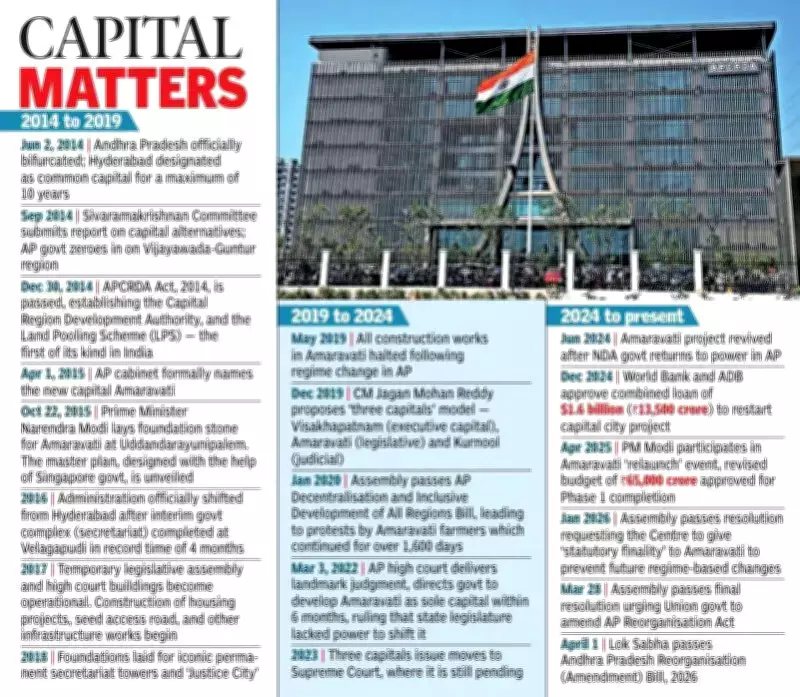
The concept of a unified civic body is not new. During the previous National Democratic Alliance (NDA) regime, the Amaravati Metropolitan Corporation was officially notified, incorporating 29 villages of Amaravati along with Tadepalli and Mangalagiri municipalities. However, following a change in state government, this proposal was scrapped. Instead, the Mangalagiri-Tadepalli Municipal Corporation was established, explicitly excluding the capital villages.
This political shift left the capital villages in a governance vacuum for the past decade. These areas are neither under Panchayatraj (rural local governance) nor municipal administration, creating significant challenges in local governance and service delivery.
Revival Under the Current Government
With the NDA government returning to power at the state level, the proposal to create a larger, more inclusive corporation has been revived. However, this initiative remains a work in progress, with no concrete timeline for implementation.
One longstanding proposal is the creation of a Greater Vijayawada Municipal Corporation. This would integrate satellite villages such as Gollapudi, Ramavarappadu, Prasadampadu, Enikepadu, Nidamanuru, Gannavaram, and areas currently under Tadigadapa municipality into a single administrative entity.
Calls for Holistic Development
Social activist Ravi Kumar argues for a broader development focus. "Beyond creating infrastructure in the core Amaravati area, the state government must prioritize the development of Vijayawada and other regions within the capital area," he states. "A unified civic body is essential for coordinated planning and equitable resource allocation across the entire capital region."
The absence of a cohesive urban local body continues to hinder the capital region's potential for integrated growth. As debates over Amaravati's legal status subside, the pressing need for effective urban governance emerges as the next critical challenge for Andhra Pradesh's administrative framework.






