

Ahmedabad Municipal Corporation Approves Major Junction Overhaul for Enhanced Safety
In a significant move to address long-standing safety concerns, the Ahmedabad Municipal Corporation (AMC) has greenlit a comprehensive plan worth Rs 20.08 crore to redesign and develop 133 key junctions across the city. This initiative aims to transform Ahmedabad's road infrastructure, making it safer for pedestrians and more efficient for drivers amidst rising traffic volumes.
Addressing Pedestrian Perils and Traffic Chaos
For years, crossing busy roads in Ahmedabad has been a hazardous endeavor, with many junctions lacking dedicated pedestrian crossings. Pedestrians have been forced to navigate through fast-moving traffic, leading to increased risks and congestion. The AMC has acknowledged that the absence of proper infrastructure at over 100 junctions has created genuine dangers, prompting this ambitious overhaul.
The approved budget, which is 47.7% higher than the initial estimate of Rs 13.59 crore, was passed in a standing committee meeting in March. It will fund a detailed traffic study of major junctions, the development of these areas, and the establishment of dedicated pedestrian crossings. Additionally, the funds will be utilized to install signage, road markings, lane lines, stop lines, and zebra crossings to improve overall road safety and organization.

Key Junctions and Development Phases
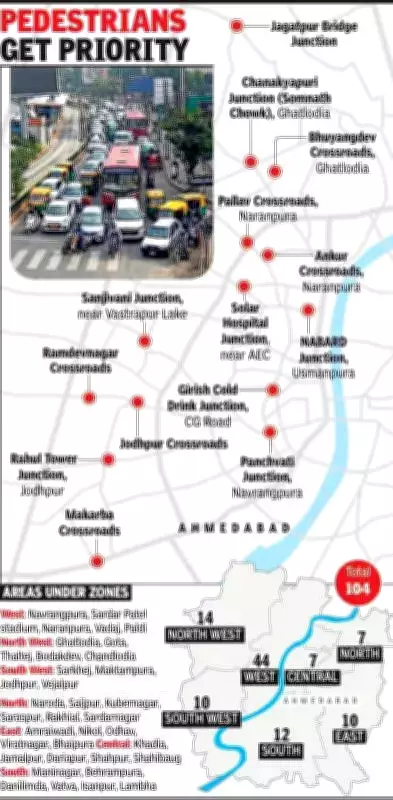
Designs for 29 junctions in the first phase have already been finalized, with plans drawn up for an additional 104 junctions, bringing the total to 133. Notable junctions on the list include:
- RTO Junction
- Nehrunagar Junction
- Palak Junction (Ranip)
- Jalaram Kutchi Bhavan
- Vijay Crossroads
- Judges Bungalow Crossroads
- Pakwan Crossroads
- Iskcon Crossroads
- Palladium Mall Junction
A senior AMC official, speaking anonymously, highlighted large circular junctions such as Mithakali, Nehrunagar, and RTO as particular problem areas. These junctions exacerbate traffic jams during peak hours and pose significant challenges for pedestrians. The official emphasized that the redesign aims to convert unused or underutilized spaces into traffic islands, clearly define lanes to improve vehicle flow, and allow free left turns based on road width to reduce congestion.
Implementation and Design Progress
The work is being rolled out in phases, with the first phase focusing on 29 junctions. Designs for 27 of these were prepared by SVNIT, while a private consultant handled the remaining two. According to the official, design work on five smaller junctions has been completed and finalized, with designs for the remaining 24 also ready. Beyond this, the AMC has prepared designs for an additional 104 junctions, ensuring a systematic approach to development.
This project represents a critical step towards enhancing urban mobility and safety in Ahmedabad, addressing both immediate hazards and long-term traffic management needs.






