

Ahmedabad Traffic Crisis: CRRI Data Reveals Alarming Surge Beyond Forecasts
For countless commuters navigating the daily grind through Ahmedabad's notorious choke points like Delhi Darwaza, Memco, and Paldi, the experience is one of relentless frustration. The slow crawl, the interminable wait at traffic signals, and the mounting delays are not just perceptions but stark realities backed by hard data. A series of comprehensive surveys conducted by the CSIR-Central Road Research Institute (CRRI) has uncovered that traffic density at five of the city's busiest junctions has skyrocketed far beyond official predictions, painting a grim picture of urban mobility challenges.
Traffic Density Soars: Key Findings from CRRI Surveys
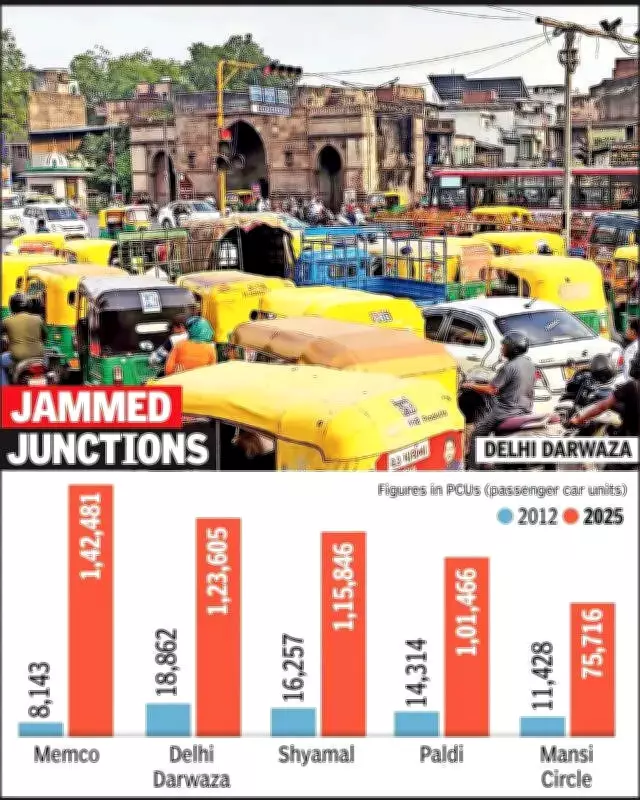
Using 2012 as a baseline year, CRRI had meticulously projected traffic levels for 2017 and 2022 after surveying 34 junctions across Ahmedabad. However, by 2025, the actual vehicle volumes at critical junctions—Shyamal, Mansi Circle, Delhi Darwaza, Memco, and Paldi—were found to be three to four times higher than anticipated, with some areas experiencing even more dramatic overruns. This discrepancy highlights a significant gap between planning and on-ground reality, as confirmed by senior officials from the Ahmedabad Municipal Corporation (AMC).
At Delhi Darwaza junction, for instance, traffic density measured in passenger car units (PCUs) was 18,862 in 2012, with projections of 26,149 by 2017 and 37,330 by 2022. Shockingly, a fresh CRRI survey in 2025 recorded a staggering 1,23,605 PCUs—more than three times the forecast. A PCU is a standardized metric that converts all vehicles into equivalent passenger cars, accounting for variations in road space usage and traffic impact, thus providing a clearer picture of congestion severity rather than mere vehicle counts.

Memco Crossroads: A Case of Extreme Overrun
The situation at Memco crossroads is even more alarming. From 8,143 PCUs in 2012, traffic was expected to rise to 15,861 PCUs by 2022. However, the 2025 survey revealed a density of 1,42,481 PCUs, described as six to eight times higher than expected. Similar patterns were observed at Shyamal, Mansi Circle, and Paldi, each logging densities five to six times above predictions. These explosive growth levels have directly translated into longer travel times, jammed intersections, and escalating commuter fatigue, underscoring the urgent need for infrastructural interventions.
Infrastructure Gaps and Renewed Planning Efforts
Despite recommendations for flyovers and underpasses during the 2012 CRRI survey, several junctions remained unaddressed as traffic multiplied over the past 14 years. This oversight has now prompted a new CRRI survey covering 25 junctions to reassess and plan effectively. Delhi Darwaza remains a particularly complex case; a flyover proposed in 2012 was stalled due to the presence of the BRTS corridor. However, with the demolition of the corridor from Delhi Darwaza to Prem Darwaza in September 2025, constraints have been removed, paving the way for renewed planning. Officials emphasize that the flyover, a priority in 2012, remains critical today.
Currently, Ahmedabad boasts 101 flyovers and underpasses, with work underway on 17 additional structures and 12 new bridges in the pipeline. These efforts aim to mitigate the congestion crisis, but the CRRI data serves as a stark reminder of the challenges ahead in aligning infrastructure development with rapid urban growth.






