

Vadodara's Century-Old Drainage Legacy Gets a Modern Upgrade
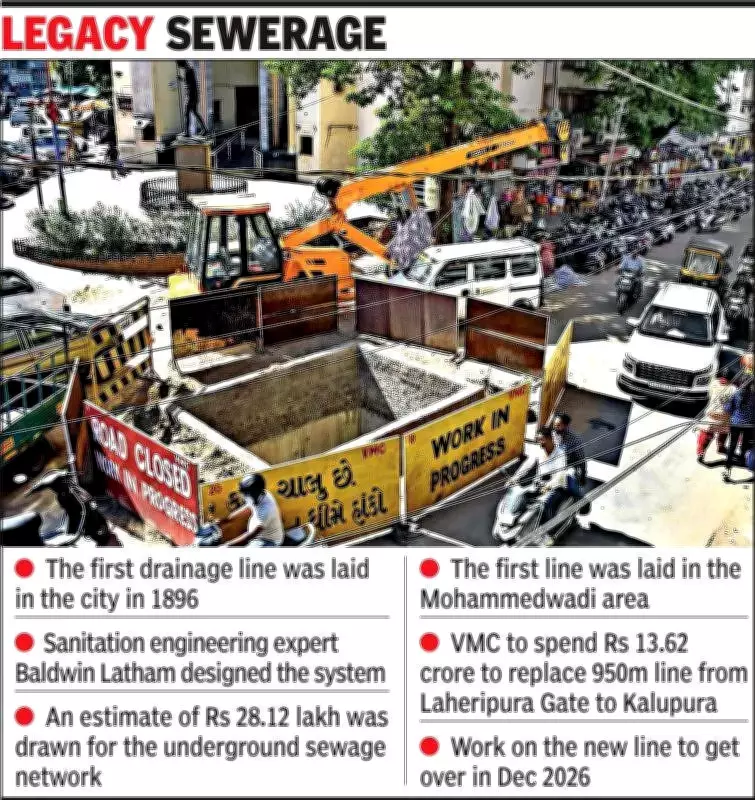
In a remarkable testament to enduring engineering, a drainage line in Vadodara has served the city faithfully for nearly 125 years. This historic infrastructure, installed during the reign of Maharaja Sayajirao Gaekwad III, is now being replaced not due to failure, but because its modest size can no longer accommodate the demands of a rapidly growing urban center.
A Historic Sewage Line Reaches Its Limits
The specific sewage line stretching from Laheripura Gate to Chhatrapati Shivaji Atithigruh in Kalupura, within the old city area, is currently undergoing replacement. This pipeline traverses key locations including Padmavati Shopping Center, Gandhi Nagargruh, Navabazaar Circle, and Kalupura, forming an integral part of the original drainage network commissioned by the visionary Gaekwad ruler.
Originally constructed with a 240 mm diameter, the line terminates at the Kalupura Auxiliary Pumping Station (APS), another infrastructure marvel from the same era. Despite its age, municipal engineers confirm the pipeline remains structurally sound, a tribute to the quality of its initial construction.

Modernization Project Underway
The Vadodara Municipal Corporation (VMC) has initiated this significant infrastructure overhaul with substantial investment. The sewage line replacement carries an estimated cost of Rs 13.62 crore, while the accompanying APS upgrade is budgeted at Rs 5.43 crore, bringing the total project expenditure to Rs 19.05 crore.
Work commenced in October of this year with an anticipated completion date in December. Once finished, the new drainage system will feature pipelines of varying diameters—400 mm, 600 mm, and 900 mm—substantially increasing capacity compared to the original 240 mm line.
Addressing Contemporary Urban Challenges
According to VMC executive engineer Haresh Rathwa, the primary issue with the existing line is its insufficient diameter, which has led to congestion within the system and occasional contamination of drinking water in certain areas. "Once the new line is installed, these complaints should end," Rathwa stated, highlighting the project's practical benefits for residents.
The need for enhanced drainage capacity reflects Vadodara's transformation from a princely state capital to a bustling modern city with expanded population and infrastructure requirements.
A Historical Journey of Sanitation Infrastructure
The story of Vadodara's drainage system begins in the late 19th century, shortly after the city introduced piped water supply on March 29, 1892. An experimental pipeline stretch laid in 1896 demonstrated promising results, but progress stalled until a critical public health emergency provided renewed impetus.
The outbreak of bubonic plague in 1898–99 revived urgency around constructing a proper sewage network, leading to coverage of large sections of the old city and Baranpura. Expansion faced temporary interruption during the famine of 1899–1900, but resumed under the Baroda State administration in 1905–06.
Maharaja Sayajirao Gaekwad III, known for attracting top expertise to his princely state, enlisted British sanitation engineer Baldwin Latham to design the city's drainage network. Latham's expertise created a system that has remarkably endured for over a century.
Enduring Markers of Engineering Heritage
Even today, residents may notice distinctive green shafts with arrows at various locations throughout the old city. These markers indicate the direction of underground sewage lines—subtle but persistent reminders of Vadodara's engineering legacy that predates Indian independence.
The replacement project represents both respect for historical infrastructure and necessary adaptation to contemporary urban realities, ensuring Vadodara's drainage system continues to serve future generations as effectively as it has served the past.






