Elderly Voter Forced to Attend Hearing on Cot in Kolkata, Sparking Outrage
In a distressing incident that has raised serious questions about the implementation of Election Commission directives, a 93-year-old ailing woman was carried on a cot to attend a hearing under the Special Intensive Revision (SIR) of electoral rolls at Ghola in North 24 Parganas, Kolkata, on Thursday.
Violation of Election Commission Guidelines
According to the Election Commission's clear guidelines, voters aged above 80 and those who are seriously ill are entitled to hearings at their homes to ensure their participation without hardship. However, this protocol was blatantly ignored when Rabeya Bibi, a bedridden resident of Ghola West Teghoria, was brought to the hearing centre at Ghola Teghoria High School on a makeshift cot.
Bibi has been confined to bed for an extended period due to illness, making travel particularly challenging. Local residents alleged that neither the booth-level officer (BLO) nor any Election Commission official visited her home to conduct the hearing as mandated.

"In protest, locals carried the nonagenarian and ailing woman on a cot to the hearing centre," said neighbour Gulshan Ali, highlighting the community's frustration with the system's failure.
Official Responses and Denials
The incident sparked immediate outrage in the area, with agitated residents surrounding the Electoral Registration Officer (ERO) at the venue. Responding to the allegations, ERO Rakhi Dutta stated, "We had instructed the BLO not to bring the ailing elderly woman to the hearing centre. Whether the BLO followed that instruction or not, she can explain."
BLO Rita Majumdar, however, denied the allegation, claiming, "I visited her house and provided a form so that a family member could attend the hearing on her behalf. But the family did not submit the form." This conflicting account leaves unanswered questions about the communication and execution of EC protocols.
Additional Cases of Voter Harassment in West Bengal
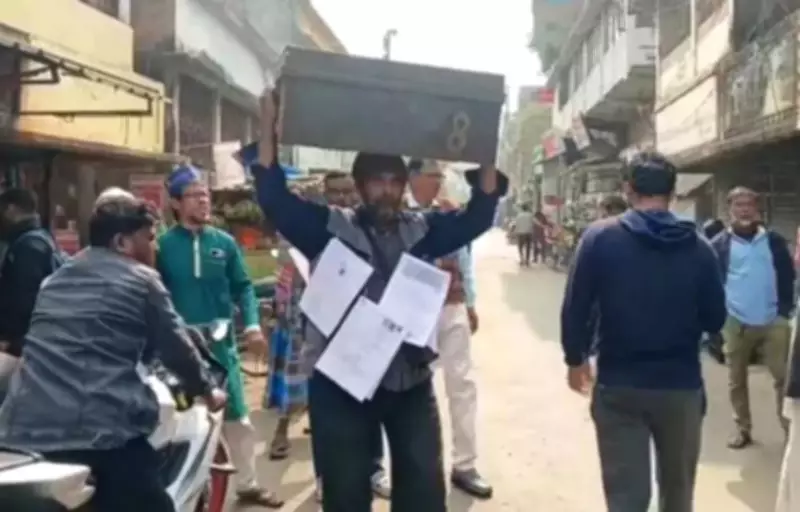
This incident is not isolated. In Midnapore, a 71-year-old voter in West Midnapore's Ghatal block arrived at an SIR hearing with a tin trunk balanced on his head after being summoned over a name discrepancy in the electoral roll.
The man, identified as Sheikh Jafar Ali of booth 187 under Ajobnagar II Gram Panchayat, was called because his name appears as ‘Sheikh Jafar Ali Sheikh' on the current voter list, while the 2002 voter list records him as ‘Jafar Ali Sheikh'. The duplication of ‘Sheikh' at both the beginning and end of his name was cited as the discrepancy.
Witnesses reported that multiple documents—including identification cards, hearing notices, and property deeds—were tied and hung from different parts of his body as he stood in line. "I am not educated and brought all family papers to the BDO office so officials could verify whatever was required," Jafar Ali explained.
At the Ghatal BDO office, the incident highlighted ongoing complaints of harassment linked to the SIR process. No official from the BLO or election authorities commented, though a police officer directed the man to take the trunk outside the premises.
Mental Distress Over Lineage Proof Demands
In another troubling case, Diyan Gayen, a nearly 50-year-old resident of Kamarpol in Diamond Harbour–II block, alleged severe mental stress after being asked to prove his lineage during an SIR hearing. Officials questioned whether he was a legitimate descendant of the Gayen family.
After furnishing his birth certificate, voter ID, and other documents, Gayen—unsure if that was sufficient—also submitted soil from his deceased grandfather's grave in a sealed plastic packet. He believed it could be used for DNA testing if required to establish his lineage.
"Why should someone whose name has been on the voter list since 2002 and who has voted uninterruptedly for years now be asked to prove his lineage?" Gayen, a voter of booth 78 under Sarisha gram panchayat, questioned. He later claimed the episode left him mentally distressed, adding, "I am an ordinary labourer and support my family with great difficulty. I cannot withstand this kind of pressure."

Systemic Issues in Electoral Roll Revision
These incidents collectively point to systemic issues in the implementation of the Special Intensive Revision process in West Bengal. The Election Commission's guidelines are designed to facilitate voter participation, especially for vulnerable groups like the elderly and ill, but ground-level execution appears lacking.
The cases underscore:
- Failure to provide home hearings for bedridden elderly voters
- Bureaucratic harassment over minor name discrepancies
- Unreasonable demands for proof of lineage from long-time voters
- Lack of clear communication between officials and citizens
As the electoral roll revision continues, these events serve as a stark reminder of the need for greater sensitivity and adherence to protocols to protect citizens' rights and dignity in the democratic process.