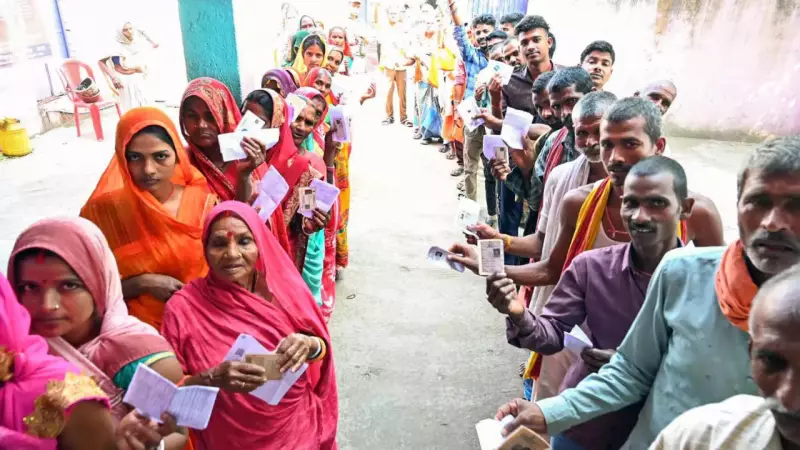
The first phase of Bihar assembly elections has created political ripples across the state with an unprecedented voter turnout of 64.66 percent recorded on Thursday. This represents a significant 8.5 percent increase compared to the 2020 assembly elections, leaving political analysts and parties scrambling to interpret what this massive participation means for Bihar's political future.
Political Interpretations of Record Turnout
Prime Minister Narendra Modi was quick to claim the high turnout as evidence of public trust in his government's performance. "Yesterday, the voters of Bihar broke all records. Never before in the history of the state has there been such a high poll percentage," Modi stated on Friday. He specifically credited women voters, referring to them as "Maatri Shakti" for their substantial participation that pushed turnout to nearly 65 percent.
However, the opposition Mahagathbandhan has interpreted the same numbers quite differently. RJD leader Tejashwi Yadav, the INDIA bloc's chief ministerial candidate, declared: "I salute the people of Bihar for the bumper voting. I can now confidently say you have affirmed the victory of 'Mahagathbandhan'." His confidence stems from his campaign promises including employment guarantees, free electricity, farm loan waivers, and the popular MAA Yojana.

Historical Patterns and Expert Analysis
Historical data from Bihar's electoral past reveals that high voter turnout often signals regime change. In 1990, voter turnout rose from 56.3 percent to 62 percent, resulting in the ousting of Jagannath Mishra-led Congress government and Lalu Prasad Yadav becoming chief minister. Similarly, in 1980, a 7 percent surge in turnout favored Congress after a three-year rule of Karpoori Thakur-led Janata Party government.
Political analyst Kumar Vijay offers a nuanced perspective: "Women voter turnout in the first phase was very encouraging. It seems that Mukhya Mantri Mahila Rojgaar Yojana, which gave Rs 10,000 to 75 lakh women, free electricity up to 125 units and increased pension may have worked for the incumbent government." He noted that anti-incumbency wasn't visibly strong despite Nitish Kumar's 20-year rule.
The X-Factors and Technical Aspects
Several unique factors are influencing this election. Migrant laborers in north Bihar, who returned for Chhath festivities and haven't returned to their workplaces, represent what analysts call the "X factor" that might benefit Prashant Kishor's Jan Suraaj party, which has made migration a central campaign issue.
Another significant factor is the Election Commission's Special Intensive Revision (SIR) drive conducted months before the elections. This purification exercise led to a substantial correction in electoral rolls, with the final list including 7.42 crore eligible voters - 18 lakh more than the draft roll but 47 lakh fewer than before the revision. The Magadh region saw voter base grow by 2.6 percent, with Patna district registering the highest increase at 3.4 percent.
The battle for these 121 seats remains crucial, as the 2020 assembly elections saw the Mahagathbandhan secure a slender edge by winning 61 constituencies against NDA's 59. With the second phase scheduled for November 11 and vote counting on November 14, all eyes remain on whether the high turnout will indeed translate into a change of government or reinforce the current administration's position.