

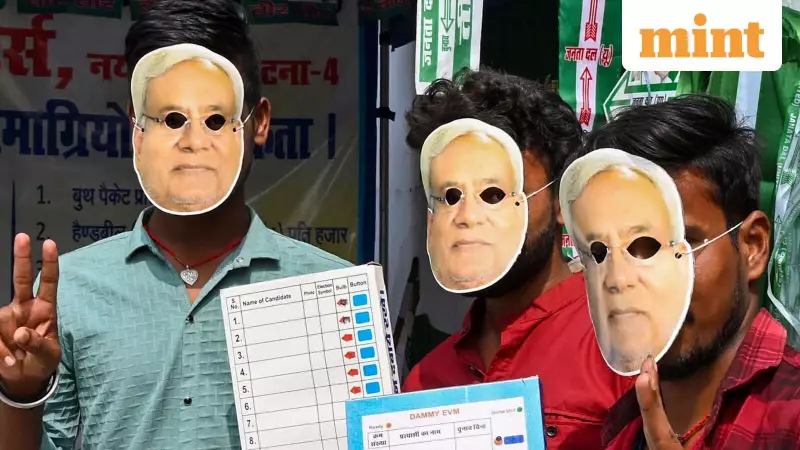
The 2025 Bihar assembly elections present a fascinating political paradox where Chief Minister Nitish Kumar finds himself competing against his own two-decade legacy. While the surface contest pits Kumar against opposition leader Tejashwi Yadav of the Rashtriya Janata Dal (RJD), the underlying battle revolves around Kumar's governance record versus public fatigue with his long tenure.
The Dual Narrative of Development and Discontent
Across Bihar's political landscape, voters are sharply divided between those who remember the state's transformation from Lalu Prasad Yadav's 'jungle raj' and younger generations demanding badlaav (change). The election, conducted in two phases from November 6 to November 11, 2025, represents a textbook Indian political contest where everyday issues dominate amid complex caste arithmetic.
The electoral backdrop reveals a closely divided state. In the 2020 assembly polls, the National Democratic Alliance (NDA) comprising Kumar's Janata Dal (United), BJP, and smaller parties won 125 of 243 seats with 37.26% vote share. The opposition Mahagathbandhan alliance of RJD and Congress secured 110 seats with 37.23% vote share, demonstrating the razor-thin margins defining Bihar's political fate.

Nitish Kumar's Governance Advantage
Kumar's strongest card remains his governance record, particularly his early achievements in transforming Bihar from a state plagued by lawlessness and economic stagnation. Supporters point to visible infrastructure development, improved law and order, and women-centric policies that have earned him the title 'Sushasan Babu' (good governance leader).
Women voters have emerged as Kumar's consistent supporters, with female voter turnout exceeding male participation since 2010. The 2020 assembly elections saw 59.7% women voter turnout compared to 54.5% for men. Recent initiatives like transferring ₹10,000 to women beneficiaries under the Mukhyamantri Mahila Rozgar Yojana have further strengthened his appeal among female voters.
Kumar's alliance with the BJP provides additional advantages, including Prime Minister Narendra Modi's popularity and a broader caste coalition spanning upper castes, extremely backward classes (EBCs), and sections of Dalits. His clean image, contrasting sharply with Lalu Yadav's corruption legacy, remains another significant asset.
Tejashwi Yadav's Change Agenda
The opposition's strongest weapon is the anti-incumbency sentiment against Kumar's 20-year rule. While there's no boiling anger, there's palpable fatigue and disillusionment, particularly among younger voters who have no memory of the RJD's problematic regime.
Unemployment has emerged as the election's central issue, with Bihar facing alarming outward migration numbers second only to Uttar Pradesh. Youth unemployment statistics reveal a worrying picture: the state's unemployment rate for 15-29 year olds stands at 16.7%, higher than the national average of 14.6%.
Tejashwi Yadav has cleverly capitalized on this discontent, promising one government job for every household if voted to power. His appeal resonates particularly with the state's 1.41 million first-time voters aged 18-19 years who prioritize employment opportunities over historical governance narratives.
Beyond Caste: Emerging Electoral Dynamics
While caste remains integral to Bihar's political calculus, this election demonstrates shifting dynamics where development issues are creating cross-cutting constituencies. Kumar pioneered this approach by cultivating women as a distinct voting bloc, while both Yadav and Prashant Kishor's Jan Suraaj Party are attempting similar strategies with youth voters.
The election ultimately represents a collision between Kumar's governance legacy and his failure to address the unemployment crisis. As voters weigh visible infrastructure gains against persistent joblessness, the verdict will depend on whether Kumar can convince constituents that despite his flaws, he remains Bihar's best hope for sustained development.

With negligible vote share differences between alliances in previous elections and multiple players including Prashant Kishor's debutant party, Bihar's political future hangs in a delicate balance between memory of past transformation and aspirations for future change.





