The recent capture of Venezuelan President Nicolás Maduro and the subsequent invocation of a nearly 200-year-old US foreign policy principle by President Donald Trump has thrust a historical doctrine back into the spotlight, revealing its enduring and controversial legacy. The Monroe Doctrine, originally crafted to ward off European empires from the Americas, is now being cited to justify modern intervention, raising alarms among scholars about a return to spheres of influence and wider global instability.
The Doctrine's Resurrection in Venezuela
For Professor Jay Saxton, a historian at the University of Missouri who once considered the Monroe Doctrine a "dead letter," its recent use has been surprising. The doctrine was born in December 1823 when President James Monroe, facing a perceived national security crisis, declared the Western Hemisphere closed to future European colonization or intervention. This message to Congress was a direct response to fears that European powers might try to recolonize newly independent Spanish American states.
However, the Trump administration's application of the doctrine to Venezuela has left experts like Alex Bryne, a lecturer at De Montfort University, confused. "There is no external, non-American threat that the United States is seeking to combat in Venezuela," Bryne points out, highlighting that the doctrine is being used against an internal Venezuelan leader, not a European power, marking a significant shift in its interpretation.

Evolution from Principle to Imperial Tool
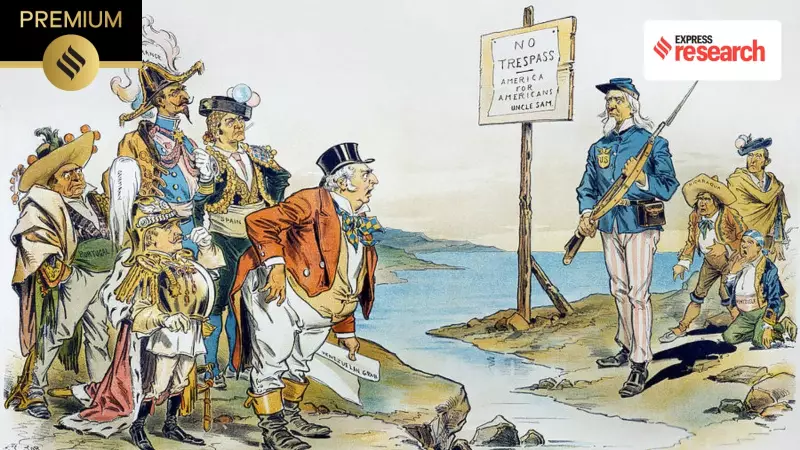
The doctrine's meaning has never been static. Its two core tenets—non-colonization and non-interference by Europe—were initially coupled with a US pledge to stay out of European affairs. Yet, as US power grew after the Spanish-American War of 1898, the doctrine's purpose became fiercely contested. Scholars identify two competing strains: one justifying US regional hegemony, and another promoting inter-American cooperation.
This ambiguity allowed for radical reinterpretation. President Theodore Roosevelt established the "Roosevelt Corollary" in 1904, asserting a US right to police Latin America to prevent European intervention. "Trump's invocation really resembles that one, the Roosevelt Corollary, much more than it does the original," notes Saxton. Bryne terms the current usage the "Trump Corollary," signifying a move towards overt imperialism without the pretext of an external threat.
The doctrine's mythological status in US political culture was cemented by episodes like the Venezuelan boundary dispute of 1895-1896, where standing up to Britain convinced US officials of their "practically sovereign" position in the hemisphere.
The Unexpected Indian Connection
The doctrine's appeal once transcended the Americas. During the fight for Indian independence, nationalist leader Bal Gangadhar Tilak appealed for a "Monroe Doctrine for India." As historian Erez Manela records, Tilak argued for a similar principle of self-determination, urging colonial powers to withdraw to allow self-rule. This interpretation overlooked the US's interventionist history in Latin America but powerfully channeled the anti-colonial hopes of the era.
Today, scholars warn that the doctrine's revival signals a dangerous return to a world divided into spheres of influence. Saxton argues it undermines US moral authority to critique actions by Russia in Ukraine or China in Hong Kong. The potential consequences are vast: regional instability in Latin America, renewed great-power rivalry, and further destabilization within US domestic politics itself.
As the events in Venezuela demonstrate, a doctrine conceived in 1823 to keep Europe out continues to echo, shaping geopolitical realities far from its original intent and reminding the world of the long shadow of historical policy.