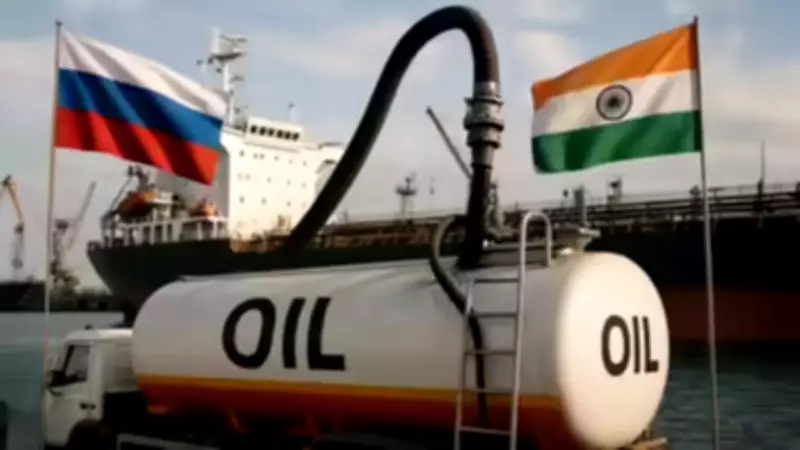
US Issues Temporary Waiver for India to Purchase Russian Oil Amid Global Supply Disruptions
The United States has announced a significant short-term measure to address rising global crude prices by granting India a temporary waiver to purchase certain Russian oil supplies. This decision comes as tensions in the Middle East, particularly involving Israel and Iran, disrupt energy shipments through critical maritime routes.
Stabilizing Global Markets Through Strategic Action
US Energy Secretary Chris Wright emphasized that this waiver is a targeted move designed to quickly bring oil stored in floating reserves into the global market. The primary goal is to ease immediate supply constraints and prevent further price spikes caused by disruptions in the Strait of Hormuz, through which nearly 40–50 percent of India's crude imports typically pass.
In an interview with ABC News Live, Wright explained that large volumes of Russian crude are currently stored in tankers around southern Asia. "We need to get oil on the market in the short term. In the long term, supplies are abundant. There's no worry there," he stated, highlighting the temporary nature of this policy adjustment.

Encouraging India to Absorb Stranded Cargoes
The US has actively encouraged India to purchase these Russian oil cargoes. Wright detailed the strategy: "We've reached out to our friends in India and said, 'Buy that oil. Bring it into your refineries.' That pulls stored oil immediately into Indian refineries and releases the pressure on other refineries around the world."
He was careful to stress that this waiver does not signify a broader shift in Washington's stance toward Moscow. "This is no change in policy towards Russia. This is a very brief change in policy just to keep oil prices down a little bit better than we could otherwise," Wright clarified, underscoring the limited scope of this exemption.
Official Announcement and Immediate Impact
Earlier, US Treasury Secretary Scott Bessent made the waiver official through a post on X, announcing a 30-day exemption. "To enable oil to keep flowing into the global market, the treasury department is issuing a temporary 30-day waiver to allow Indian refiners to purchase Russian oil," he declared.
Following this announcement, Indian refiners have swiftly moved to capitalize on the opportunity. According to reports from news agency PTI, these companies have begun purchasing large volumes of Russian oil floating in Asian waters, snapping up around 20 million barrels of crude. Most of these purchases are from non-sanctioned entities, though refiners are seeking legal clarity on whether the exemption extends to sanctioned firms as well.
Addressing India's Energy Security Needs
This waiver arrives at a critical time for India's energy security. The country holds reserves covering roughly 25 days of crude demand and has increasingly turned to Russian cargoes at sea to ensure stable domestic fuel supplies. Indian refiners had already been importing about one million barrels of Russian oil per day in recent months, making this waiver a logical extension of existing trade patterns.
Industry estimates cited by PTI suggest that approximately 15 million barrels of Russian crude are currently floating in the Arabian Sea and the Bay of Bengal. Additional cargoes are waiting near Singapore and other routes, which could reach Indian ports within weeks if purchased under this exemption.
Broader Implications and Future Outlook
The US Treasury's Office of Foreign Assets Control has issued a specific license permitting the delivery and offloading of Russian crude loaded on vessels before March 5, 2026, with transactions allowed until April 4, 2026. This provides a clear legal framework for the temporary purchases.
Analysts note that while the waiver offers short-term relief for India's energy security, competition from other buyers, particularly China, may limit the volume of additional Russian oil available. The widening West Asia conflict continues to pose risks to global energy stability, making such targeted interventions necessary to manage market volatility.

This strategic move by the US reflects a pragmatic approach to global energy dynamics, balancing geopolitical considerations with economic realities to mitigate the impact of regional conflicts on worldwide oil supplies.