In a significant move to bolster regional security, the United States has committed a substantial financial assistance package totalling $45 million for Thailand and Cambodia. The aid is specifically designed to reinforce a delicate ceasefire agreement and foster long-term stability along the contentious border shared by the two Southeast Asian nations.
Details of the US Assistance Package
The announcement was delivered by Michael DeSombre, the US Assistant Secretary of State for East Asian and Pacific Affairs, during a virtual press briefing held from Bangkok on Friday. DeSombre is currently on a diplomatic tour engaging with officials from both countries. He detailed the allocation of the funds, which is aimed at supporting the implementation of peace accords finalised last year following deadly border confrontations.
The $45 million package will be distributed across three critical areas:

- $15 million for border stabilisation initiatives to aid community recovery and support individuals displaced by the conflict.
- $10 million dedicated to demining operations and the clearance of unexploded ordnance, a persistent lethal threat in the region.
- $20 million for programmes targeting transnational crime, including drug trafficking and online scam networks.
DeSombre noted that the precise mechanisms for utilising these funds are still in the process of being finalised by the relevant authorities.
Background of the Border Conflict
The border between Thailand and Cambodia, stretching approximately 800 kilometres, has been a source of tension for decades, with its origins tracing back to colonial-era demarcations. The most recent violent episodes, which flared up in July and again in December, resulted in a tragic human cost. Reports indicate the clashes displaced hundreds of thousands of people and led to the deaths of roughly 100 soldiers and civilians.
Both nations have historically exchanged accusations over the violence, with several disputed zones—including areas containing ancient temple ruins—remaining flashpoints. A major ongoing hazard is the prevalence of landmines. Cambodia is still grappling with remnants from its civil war, while Thailand has alleged that new mines were laid recently, causing injuries to its soldiers during patrols.
The Path to a Fragile Ceasefire
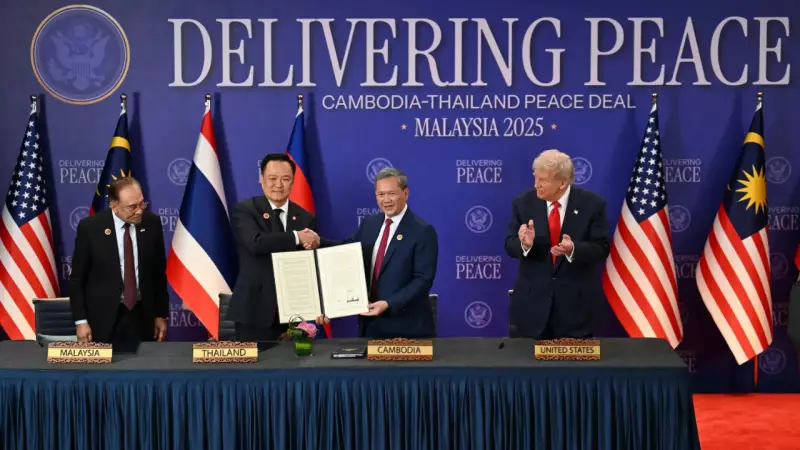
The formal ceasefire, known as the Kuala Lumpur Peace Accords, was cemented in October at a regional summit in Malaysia attended by then-US President Donald Trump. Initial agreements to halt fighting in late July saw sluggish progress until Trump's personal intervention, linking the continuation of hostilities to a stall in potential trade agreements with Washington.
Despite this high-level pact, fresh clashes erupted early last month, underscoring the fragility of the peace. After three weeks of renewed fighting, defence ministers from Thailand and Cambodia signed a renewed commitment on December 27, pledging to uphold the October agreement. Thailand subsequently accused Cambodia of breaching the truce, a claim Phnom Penh dismissed as accidental.
In his statement, Assistant Secretary DeSombre reaffirmed Washington's dedication. "The United States will continue to support the Cambodian and Thai governments as they implement the Kuala Lumpur Peace Accords and pave the way for a return to peace, prosperity and stability for their people and the region," he said.
This aid package marks a notable shift in US engagement in Southeast Asia. Last year, American assistance to the region saw sharp cuts following the Trump administration's decision to shutter the US Agency for International Development (USAID). The new funding signals a renewed focus on security, stability, and strategic US interests in the Indo-Pacific, aiming to transform a tense border into a zone of cooperative recovery.