US Official Details Alleged Chinese Nuclear Test from 2020
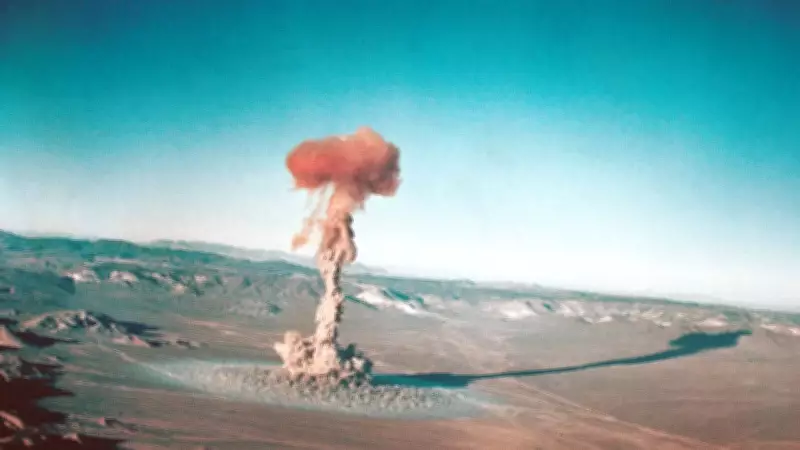
A senior United States official has publicly disclosed what he termed as new specifics regarding an alleged underground nuclear test conducted by China in June 2020. This assertion is based on seismic data recorded in Central Asia, a claim that Beijing has vehemently rejected as baseless and politically driven.
Seismic Detection and Official Statements
Speaking at an event hosted by the Hudson Institute in Washington on Tuesday, Assistant Secretary of State Christopher Yeaw revealed that a remote seismic station in Kazakhstan, designated as PS23, detected an explosion with a magnitude of 2.75 on June 22, 2020. The signal was traced back to China's Lop Nor test grounds, located approximately 450 miles (720 kilometers) away in the western part of the country.
"I've looked at additional data since then. There is very little possibility I would say that it is anything but an explosion, a singular explosion," Yeaw stated, as quoted by Reuters. He emphasized that the seismic patterns were inconsistent with typical mining blasts or natural earthquakes, aligning instead with what would be expected from a nuclear explosive test.

CTBTO's Role and Data Limitations
The seismic station PS23 is part of the global monitoring network operated by the Comprehensive Nuclear-Test-Ban Treaty Organization (CTBTO), which is tasked with detecting nuclear test explosions. However, CTBTO Executive Secretary Robert Floyd noted that the organization recorded "two very small seismic events" 12 seconds apart on that date, both far below the threshold for confident detection of nuclear tests—set at yields equivalent to 551 tons of TNT or greater.
Floyd explained, "These two events were far below that level. As a result, with this data alone, it is not possible to assess the cause of these events with confidence." This highlights the challenges in verifying such allegations without more conclusive evidence.
China's Firm Rejection and Political Context
China has categorically denied the allegations. Liu Pengyu, a spokesperson for the Chinese embassy in Washington, labeled the claim as "entirely unfounded" and accused the US of fabricating excuses to resume its own nuclear testing. In an emailed statement, Liu asserted, "This is political manipulation aimed at pursuing nuclear hegemony and evading its own nuclear disarmament responsibilities." He urged the US to reaffirm commitments against nuclear tests and uphold global non-proliferation efforts.
Technical Aspects: The Decoupling Method
Yeaw suggested that China might have employed a technique known as "decoupling" to conceal the alleged test. This method involves detonating a device inside a large underground chamber to reduce the shockwaves detected by seismic sensors. In a fully decoupled blast, most explosive energy increases gas pressure within the cavity rather than transmitting into surrounding rock, making seismic signals weaker and harder to identify compared to well-coupled explosions.
Broader Implications and Nuclear Arms Control
This allegation emerges amid escalating concerns over nuclear arms control, particularly following the expiration of the New START treaty on February 5. US President Donald Trump has pressured China to join negotiations with Washington and Moscow for a replacement agreement, a proposal Beijing has rejected, citing its significantly smaller nuclear arsenal. The Pentagon estimates that China possesses over 600 operational warheads and is expanding its strategic nuclear forces, potentially exceeding 1,000 warheads by 2030.
Both China and the United States have signed but not ratified the 1996 treaty banning nuclear tests. China denies conducting any underground nuclear blasts since 1996, while the US last performed an underground test in 1992. The ongoing tensions underscore the fragile state of international nuclear diplomacy and the need for transparent verification mechanisms.