

UAE and US Deepen Strategic Ties with Critical Minerals Framework
The United Arab Emirates and the United States have taken a significant step to enhance their strategic partnership by signing a new framework aimed at securing the supply of critical minerals and rare earths. This move comes as global demand for these essential materials is projected to surge dramatically in the coming decades, driven by their vital role in defense systems, advanced technologies, and sustainable industrial growth.
Signing Ceremony and Strategic Context
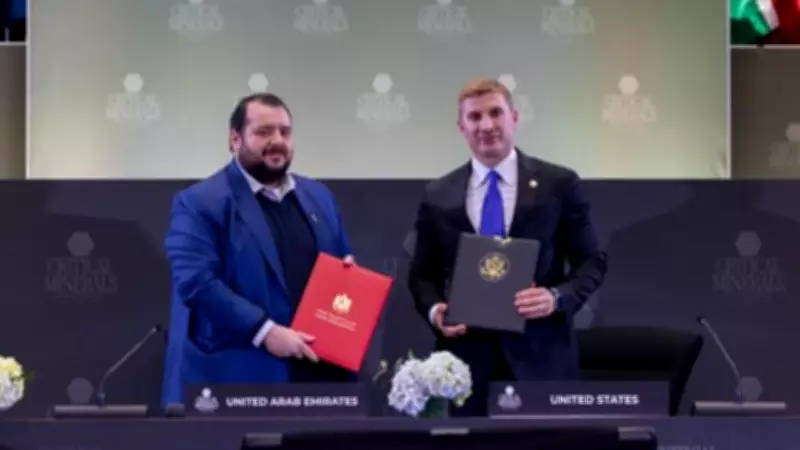
The Framework on Securing Supply in the Mining and Processing of Critical Minerals and Rare Earths was formally signed on the sidelines of the US Critical Minerals Ministerial in Washington, DC. The agreement was inked by Mohamed Hassan Alsuwaidi, the UAE's Minister of Investment, and Jacob Helberg, the US Under Secretary of State for Economic Affairs. This signing occurred during the Ministry of Investment's participation in the ministerial, where the UAE engaged with over 50 global counterparts to advance cooperation on secure and resilient critical minerals supply chains.
The framework reflects a shared commitment to building diversified and resilient supply chains that are crucial for national security and economic stability. By leveraging existing policy tools, including the United States' industrial demand and stockpiling infrastructure alongside the UAE's strategic reserves, both nations aim to accelerate secure supplies through a coordinated approach.

Key Components of the Agreement
The framework outlines several critical areas of cooperation designed to mobilize public and private investment across the entire value chain. This includes activities from mining and separation to processing, recycling, and downstream operations. Both sides are committed to supporting investment through a variety of mechanisms:
- Financing and guarantees to de-risk projects
- Equity investments and offtake arrangements
- Insurance and regulatory facilitation to streamline processes
- Joint identification of priority projects to address supply chain gaps
Within six months of signing, steps are expected to be taken to provide financing to projects located in both countries, with end products intended for delivery to buyers in the UAE and US markets. This accelerated timeline underscores the urgency of addressing supply chain vulnerabilities.
Enhancing Market Resilience and Cooperation
The agreement also focuses on strengthening market resilience through several initiatives:
- Addressing non-market policies and unfair trade practices that distort global supply chains
- Exploring high-standard market mechanisms to promote transparent and reliable trade
- Collaborating with international partners to tackle global pricing challenges
- Investing in recycling technologies and improving management of critical minerals scrap
- Conducting geological mapping efforts in mutually agreed locations to identify new resources
- Enhancing review of asset sales on national security grounds to protect strategic interests
- Working with third parties to further strengthen overall supply chain security
These measures are designed to create a more robust and predictable market environment, reducing dependencies on single sources and mitigating risks associated with geopolitical tensions.
Leadership Perspectives and Future Outlook
Commenting on the agreement, Minister Alsuwaidi highlighted the exponential growth in demand for critical minerals, which is expected to triple by 2030 and quadruple by 2040. He emphasized that sustained and coordinated investment is essential to meet this demand and ensure long-term economic security.
Under Secretary Helberg described the UAE as a key US partner, noting the UAE's substantial investment commitment of US$1.4 trillion in the United States over the next decade. He underscored that this framework not only strengthens economic ties but also enhances national security cooperation between the two nations.
This strategic partnership positions both countries to better navigate the complexities of the global critical minerals market, fostering innovation, security, and economic growth in an increasingly interconnected world.






