

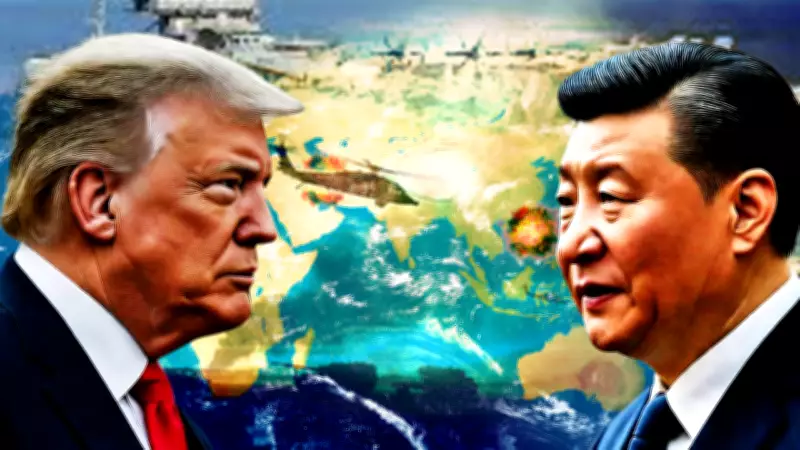
The Thucydides Trap in 2026: A Modern Rivalry Echoing Ancient Fears
What transforms a geopolitical rivalry into a full-scale war? Historical analysis suggests it is rarely driven solely by ideology or ambition. More frequently, it is a toxic cocktail of fear, strategic miscalculation, and the failure of established international systems to adapt to shifting power dynamics. As we navigate the second quarter of the 21st century, the United States and China find themselves locked in a defining rivalry. This contest is not characterized by open warfare but by escalating tariffs, stringent technology controls, and intensifying military competition across new domains. Both nations publicly disavow a desire for conflict, yet a profound and mutual distrust permeates their interactions. This dangerous combination has precedent in history, often with catastrophic outcomes.
Echoes of 1914: The Peril of Sleepwalking into Conflict
The contemporary global landscape carries unsettling echoes of the "long summer" of 1914. In that era, Europe's great powers were intricately connected through trade networks, diplomatic channels, and shared aristocratic elites. Despite these bonds, they tragically sleepwalked into a devastating world war that none had genuinely sought. Today, with a "Silicon Trap" tightening around the Western Pacific and a tariff blitzkrieg emanating from Washington, a critical question arises: Could a cyberattack, a misread military signal, or an unintended maritime collision become the modern equivalent of the Sarajevo assassination—the spark that ignites a broader conflagration?
The Genesis: A 2,500-Year-Old Warning from Thucydides
At the core of this geopolitical anxiety lies the Thucydides Trap, a concept with roots in ancient Greek history. The term originates from the Athenian historian Thucydides, who chronicled the Peloponnesian War that devastated classical Greece's leading city-states. His seminal observation was: "It was the rise of Athens and the fear that this instilled in Sparta that made war inevitable." This insight captures the structural stress when a rising power challenges an established hegemon.

Harvard Professor Graham Allison formally coined the term "Thucydides Trap" a decade ago to apply this ancient wisdom to contemporary US-China relations. He describes it not as a prediction of inevitable war, but as a warning of intense structural pressure. When such a power shift occurs, Allison argues, "alarm bells should sound," as the involved parties become exceptionally vulnerable to third-party provocations or accidental escalations.
The Tectonic Shift in Global Power
The current friction is propelled by what Allison terms "Tectonics"—the fundamental realignment of relative power between the US and China since the Cold War's end. In just thirty-five years, China's economy has skyrocketed from less than one-tenth the size of the US economy to surpassing it in terms of Purchasing Power Parity (PPP). Allison employs a playground metaphor: envision the US and China on a seesaw, with each side's GDP represented by their weight. As China grew, America's feet gradually lifted off the ground, a shift now palpable across every dimension, from artificial intelligence research to naval capabilities.
Professor Swaran Singh of Jawaharlal Nehru University's School of International Studies highlights that this shift has critically weakened the "economic glue" that once fostered global stability. "US President Trump's tariff blitzkrieg has weaponised interdependence," Prof. Singh explains in an exclusive interaction. "His selective decoupling with major economies, including China, threatens to reduce the complex-interdependence that once ensured high stakes in stability, with higher costs for conflict."

The Silicon Trap and Clashing Exceptionalism
Nowhere is this friction more visible than in the desperate race for semiconductor dominance—the "Silicon Trap." For Beijing, achieving "chip self-sufficiency" is central to the "China Dream." For Washington, it is a matter of "existential security." Professor Singh warns that the intersection of "industrial nationalism" and "militarized technologies" has dangerously narrowed the margin for accidental escalation. "Supply-chain redundancy now substitutes efficiency, lowering escalation thresholds," he elaborates.
Adding fuel to this volatile mix are conflicting narratives of exceptionalism. Allison draws an analogy to America's expansion under President Teddy Roosevelt and his assertion of the Monroe Doctrine. Similarly, China, under Xi Jinping's "China Dream," views the Asia-Pacific as its natural sphere of influence. This clash creates what Thucydides identified as "fear" in the status quo superpower and "arrogance" in the rising aspirant.
Historical Scorecard: 16 Cases, 12 Wars
Allison's research at the Harvard Belfer Center examined the last 500 years for instances where a rising power challenged a ruling one. Of the 16 cases identified, a staggering 12 culminated in war. The four exceptions that avoided bloodshed required "huge, painful adjustments in attitudes and actions" from both sides. As we stand in early 2026, the pressing question is no longer whether we are in the Trap, but whether the US and China can muster the political will to make such drastic changes and consciously choose peace.
The Mirage of a "Reverse Kissinger" Strategy
In 1972, Henry Kissinger and Richard Nixon's secret diplomatic opening to China was a masterstroke of realpolitik. Today, some in Washington speculate about a "Reverse Kissinger" strategy—an attempt to drive a wedge between Russia and China. However, Professor Singh suggests this idea may be a relic. "Russia's structural dependence on China—markets, technology substitution, diplomatic cover—has deepened," he observes, referencing their "no limit" partnership. While their axis is transactional rather than ideological, with underlying frictions, a full reversal seems unlikely, though selective wedges might reduce its coherence.
Taiwan: The Potential Sarajevo Spark
Strategists increasingly point to Taiwan as the most dangerous potential flashpoint—a modern Sarajevo moment. For China, Taiwan represents an existential national unity issue. In a recent address, President Xi Jinping invoked the "bond of blood and kinship" and declared reunification "unstoppable." The US, bound by law, is committed to aiding Taiwan's defense. In a Thucydidean dynamic, as Allison notes, "misperceptions are magnified, miscalculations multiplied, and risks of escalation amplified."
The Weakened Restraint of the Liberal Order
The post-1945 liberal economic order—embodied by institutions like the WTO and IMF—once acted as a powerful shock absorber, socializing restraint through shared growth incentives. Professor Singh notes this framework is now hollowed out. "The liberal economic order still matters, but its restraining power has weakened considerably," he states. "The US-China-Russia triangle operates increasingly outside WTO logic, relying on blocs, sanctions, and state capitalism."
Strategic Accommodation: A Fragile Path to Peace
Is there a viable exit ramp? Allison proposes "Strategic Accommodation"—radical, often painful adjustments where the status quo power concedes some influence to the rising power, and vice versa. However, Prof. Singh highlights the domestic political fragility of such moves in 2026. "Acknowledging Chinese spheres of influence risks domestic MAGA backlash over 'appeasement,'" he explains. "For China, limits on technology or military expansion threaten regime legitimacy." The only feasible accommodation may be tacit, incremental, and deniable—focusing on rules of restraint for Taiwan contingencies, AI-military escalation, and crisis hotlines.
Clues for Crafting a Strategy of Peace
The ultimate question for our generation is whether we can become the rare historical exception. Allison's work is a call for skillful statecraft. He advocates for both nations to become "Rivalry Partners"—intensely competitive in traditional arenas but cooperative on existential threats like climate change, nuclear proliferation, and unregulated AI.
The "economic glue" is thinning, the "Silicon Trap" is closing, and new axes are hardening. The Thucydides Trap is undeniably set. Yet, as history also shows, the Trap is not an inescapable destiny; it is a choice. The path to war or peace now rests on the decisions of leaders in Washington and Beijing. They can no longer afford to ignore the historical warnings echoing from ancient Greece to the present day.





