From Ancient Greece to Modern Davos: Thucydides' Wisdom for India's Global Positioning
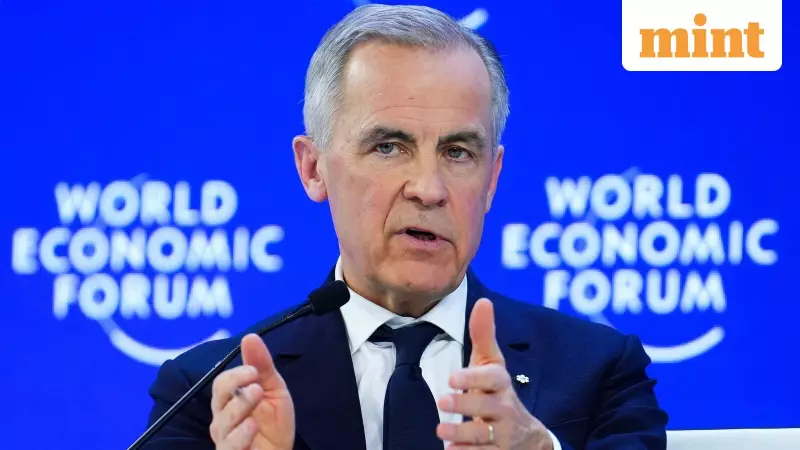
At the recent World Economic Forum in Davos, Canadian Prime Minister Mark Carney delivered a thought-provoking address that resonated with historical echoes from ancient Greece. His central argument focused on the apparent decline of the international "rules-based order" and its gradual replacement by a "might is right" paradigm. This profound rupture in global governance, according to Carney, demands urgent attention and strategic action from middle powers worldwide.
The Thucydidean Parallel: Ancient Insights for Modern Realities
Carney's analysis drew explicit parallels with the work of Thucydides, the renowned historian and general from ancient Greece who chronicled the Peloponnesian War approximately 2,400 years ago. In his seminal work, History of the Peloponnesian War, Thucydides explored the complex dynamics between Athens, a naval superpower, and Sparta, a formidable land-based power, offering timeless insights into power politics and human nature.
Through compelling dialogues like the Melian debate—where Athens displayed unapologetic hegemony toward neutral Melos—and the Mytilenean debate—featuring intense arguments about punitive measures—Thucydides revealed how fear, honor, and self-interest fundamentally drive international relations. His nuanced perspective demonstrated that while power dynamics are inevitable, the consequences of ignoring moral imperatives often lead to devastating conflicts and humanitarian crises.

Carney's Call to Action: Middle Powers as Stabilizing Forces
In his Davos presentation, Prime Minister Carney proposed that middle powers should form strategic coalitions to address the current global rupture. This approach represents a pragmatic middle ground between pursuing narrow national interests and upholding international values—a concept deeply rooted in Thucydidean thinking. The ancient historian documented how Sparta successfully countered Athenian expansion by forming the Peloponnesian League, demonstrating that alliances among significant but non-superpower states could effectively balance against dominant powers.
This historical lesson finds contemporary relevance as the United States and China engage in intensifying rivalry with diminishing constraints. Carney warned against complacency, suggesting we've entered an era of "manthan" or churn where the old order has collapsed but the new one remains undefined. Recent events, such as the collective response of Denmark, France, Germany, and Canada to protect Greenland's territorial integrity against potential U.S. actions, illustrate how middle powers can unite when core principles are threatened.
India's Strategic Dilemma in the New Global Landscape
For India, these developments present both opportunities and challenges. Historically, India has positioned itself as a swing power, aligning with the Global South on issues like agricultural trade while cooperating with Western nations on Indo-Pacific security matters. This flexible approach has allowed India to maintain productive relationships with diverse partners including democratic nations, the UAE, Russia, and Iran, while actively participating in multilateral forums like BRICS and the G-20.
However, Carney's analysis suggests that in an era of full-blown great power rivalry, middle powers like India may face increasing pressure to choose clearer alignments rather than maintaining issue-based flexibility. The potential reform or decline of post-war institutions—from the International Monetary Fund and United Nations Security Council to specialized agencies addressing health, labor, and agriculture—could fundamentally reshape the international landscape India has navigated so successfully.
The Future of Global Governance: Multiple Scenarios Ahead
Looking forward, several possible trajectories emerge from the current uncertainty. One scenario involves a modified multilateral order with stricter immigration controls and greater tolerance for national self-interest, where some existing institutions reform while others fade away. Alternatively, the world might descend into explicit great power competition with middle powers forced into alignment based on strategic calculations rather than shared values.

As Thucydides famously observed, "History is philosophy teaching by example." For India, the ancient historian's insights about power dynamics, alliance formation, and the tension between morality and realpolitik offer valuable guidance as the nation navigates this transitional period in global affairs. The decisions India makes in responding to Carney's call for middle power coalitions will significantly influence not only its own future but the character of the emerging international order.