The Yes, Minister Joke That Became Britain's Political Reality
The classic British political satire Yes, Minister featured a recurring gag where the Prime Minister discovers, with growing frustration, that his sovereignty is more illusion than reality. The humor stemmed from the gap between Britain's imperial posture and its actual dependence on American protection. This joke has resurfaced with painful relevance in the era of Prime Minister Keir Starmer and former President Donald Trump.
A Special Relationship Under Strain
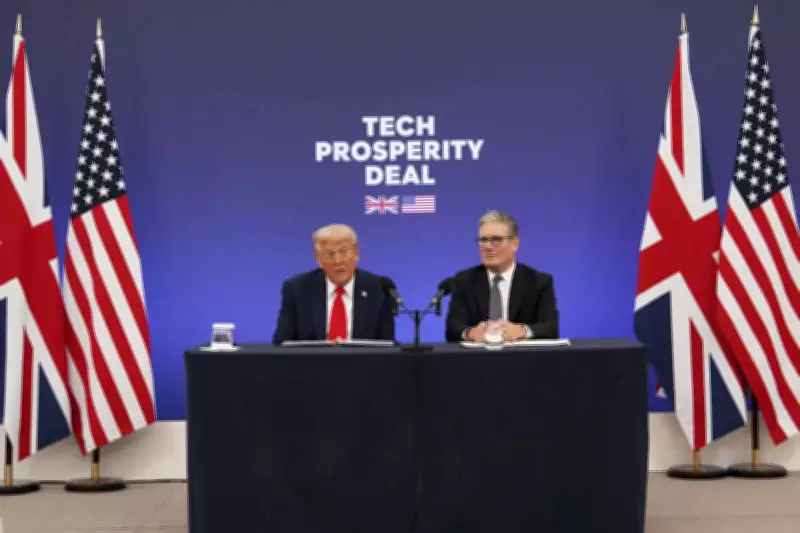
Recent sketches imagining Starmer anxiously preparing for calls with Trump capture the dynamic perfectly. What was once framed as a "special relationship" now resembles a performance review. Starmer's irritation has been unusually visible for a British leader. "I'm fed up," he declared, directly linking rising energy costs to decisions by Trump and Vladimir Putin. This marked a significant tonal shift.
British prime ministers traditionally avoid blaming American presidents for domestic problems, preferring to absorb, deflect, or reframe criticism. Tony Blair famously supported wars over non-existent weapons of mass destruction. Starmer, however briefly, assigned blame directly.

Trump's Undiplomatic Approach
Trump has reciprocated with none of the diplomatic politeness that typically oils transatlantic relations. He has called Starmer "not helpful," claimed the UK was "not our best" ally, and publicly mocked his consultative decision-making style with a caricatured voice: "I'll have to ask my team... we're meeting next week."
Trump has treated Britain as he has treated Europe and NATO—as entities not carrying their weight. Starmer has attempted to draw lines, stating Britain won't repeat "mistakes of Iraq" and will act only on a "lawful basis." Yet compared to European leaders like France's Emmanuel Macron—who openly mocked Trump's inconsistency—Starmer's irritation appears more like discomfort than defiance.
The Lawyer-Prime Minister's Constrained Language
When the US launched military strikes, Britain didn't join directly. Instead, it allowed American use of British-controlled bases, framing this as defensive or logistical support rather than offensive participation. This reveals Starmer's approach: calibrated, qualified, anchored in process. It's the language of a lawyer-prime minister, but also the language of constraint.
Britain didn't refuse America outright. It said not yet, not fully, and not on your terms. This distinction matters greatly in Westminster but barely registers in Washington.
Political Opportunities and Domestic Challenges
For Starmer, Trump's volatility presents an obvious political opportunity. Against American impulsiveness, he can project steadiness. Against spectacle, he can offer competence. Allies frame this as a defining moment for a prime minister often accused of drift to appear decisive through measured restraint.
However, while Starmer may gain stature internationally, he's losing ground domestically. British politics has entered unprecedented territory where both traditional parties—Conservatives and Labour—face structural threats from new political forces.
- Reform UK on the right, led by Nigel Farage, presents itself as Trump's ideological counterpart in Britain. Every American assertion becomes a campaign argument; every Downing Street hesitation becomes a weakness.
- The Green Party on the left consolidates a progressive bloc increasingly skeptical of Starmer himself. For this electorate, Starmer's rebuke of Trump feels procedural—too late, too little, too cautious.
The Sovereignty Paradox Post-Brexit
This leaves Starmer stranded in the political middle—too cautious for a country drifting toward sharper choices, too managerial for a moment demanding narrative. The paradox of his premiership: he looks more prime ministerial the further away the problem is. War forces decisions and provides clarity; domestic politics demands conviction and exposes him.

Trump understands this instinctively. His politics builds on projection—strength declared rather than demonstrated, action performed even when contradictory. Starmer waits for alignment: legal, political, institutional. This makes him safer but slower, and in a fragmented political landscape, slowness reads as absence.
The deeper irony: Brexit was sold as sovereignty reclamation, but Trump's presidency reveals its limits. Britain remains tied to American security architecture, intelligence networks, and military infrastructure in ways that cannot be easily disentangled. The base access question made this painfully clear. Independence, it turns out, is often conditional.
The European Hedge and Political Costs
This explains Starmer's instinct to look toward Europe, however cautiously. Not as a grand pivot but as a hedge—through energy cooperation, defense alignment, and regulatory proximity. These are attempts to reduce exposure to volatility emanating from Washington. Paradoxically, Trump may be pushing Britain closer to Europe.
Yet this too carries political costs. For a significant electorate segment, the argument is no longer about alignment but control—and neither Brussels nor Washington represents control.
The Consequence Problem
Starmer returns to the problem he cannot avoid. He can be right about Trump, justified in his caution, even vindicated by events. But unless this translates into tangible results—lower costs, greater stability, clearer direction—it remains abstract. Politics doesn't reward correctness; it rewards consequence.
Currently, consequence is claimed by those offering certainty over calibration, clarity over caution, and anger over restraint. Starmer bets the country still prefers competence to chaos. Early signs suggest the country isn't so sure.
From Satire to Diagnosis
The old Yes, Minister joke now feels less like satire and more like diagnosis. A British prime minister, caught between sovereignty language and dependence reality, performing independence while negotiating its limits—this defines post-Brexit Britain. Or as the show itself put it: "Responsibility without power—the prerogative of the eunuch throughout the ages."
Britain's journey from empire to constrained sovereignty continues, with Starmer navigating the narrow space between American dependence and European realignment while domestic politics fragments around him. The special relationship endures, but its terms have fundamentally changed, revealing the sobering reality behind the political comedy.