

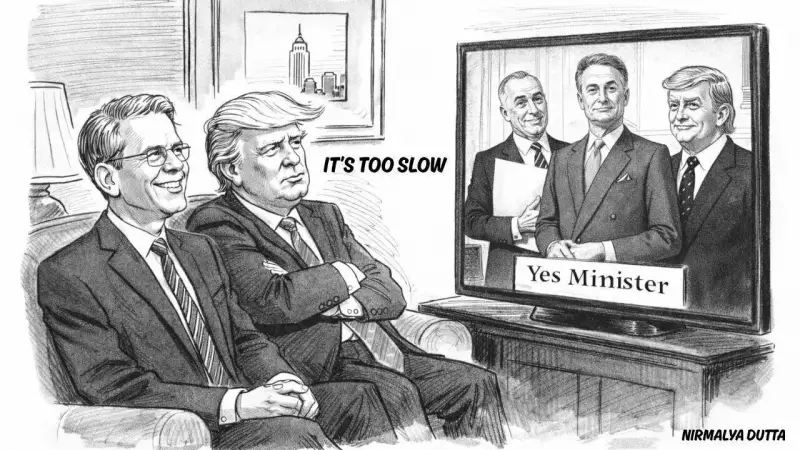
The Curious Case of Scott Bessent's Political Reasoning
Scott Bessent, appointed as Treasury Secretary in November 2024, represents one of the more intriguing figures within the Trump administration. His background raised eyebrows from the beginning – an openly gay man who once co-hosted a fundraiser for Al Gore in 2000 and spent years working at Soros Fund Management, the investment firm of Democratic mega-donor George Soros, who remains a frequent target of MAGA criticism.
Washington insiders initially believed Bessent might provide a sobering influence on President Trump, but this optimism has proven largely unfounded. Instead, Bessent's tenure has been marked by dramatic moments, including an incident where he reportedly rugby-tackled Elon Musk, and increasingly controversial public statements that reflect Trump's influence more than his own moderating presence.
The Flawed NATO Argument
Bessent's recent comments to ABC News revealed a particularly problematic line of reasoning. When questioned about European allies being insulted by Trump's NATO criticisms, Bessent argued that Europe was essentially financing Russia's war against itself through its trade relationship with India. His logic followed this pattern: America imposed 25% tariffs on India for purchasing Russian oil, while Europe was preparing to sign a major trade deal with India. Since Russian oil goes to India for refining and then gets purchased by Europeans, Bessent concluded Europe was funding the war.

This argument represents what political theorists might call "political syllogism" – a logical fallacy where correlation gets mistaken for causation. The reasoning bears striking resemblance to the cat-dog analogy famously explained in the British television series Yes Minister: "All cats have four legs. My dog has four legs. Therefore, my dog is a cat."
Historical Context and Economic Reality
Bessent's argument collapses under historical scrutiny. When Russia invaded Ukraine in 2022, India imported barely 1-2% of its crude oil from Russia, making it insignificant in global energy markets. Only after Western sanctions disrupted global supply and sent prices soaring did India increase its Russian oil purchases – a move that senior U.S. officials, including then-Treasury Secretary Janet Yellen, quietly welcomed at the time.
The economic logic was straightforward: by purchasing discounted Russian crude, India helped keep global petroleum prices from exploding, which in turn helped control inflation in Western nations. Multiple U.S. officials acknowledged this benefit, with State Department energy envoy Geoffrey Pyatt and later U.S. Ambassador to India Eric Garcetti both recognizing India's stabilizing role in global energy markets.
The EU-India Trade Deal Timeline
The proposed EU-India trade agreement has been in negotiation since 2007 – seven years before Prime Minister Narendra Modi's first term and long before current geopolitical tensions. The deal's slow progress reflects typical bureaucratic pace rather than recent political developments. As French President Emmanuel Macron noted at the World Economic Forum, such processes are "too slow, for sure, and needs to be reformed, for sure, but which is predictable, loyal."
The eventual agreement would create a marketplace serving approximately 2 billion people, representing about 25% of the world's population. While Trump's tariff threats may have accelerated negotiations, the foundation for this deal was laid years before his administration.
Selective Criticism and Global Hypocrisy
Bessent's selective targeting of India reveals broader inconsistencies in international criticism. China purchases significantly more Russian crude than India, yet faces less public condemnation. Extending Bessent's logic would create absurd conclusions: any country trading with any nation would be supporting that nation's policies, whether buying oil from Iran, trading with Pakistan, or conducting business with the United Kingdom.

This selective outrage reflects what Martinique poet and politician Aimé Césaire observed about European bourgeois attitudes: "What he cannot forgive Hitler for is not the crime in itself, the crime against man; it is not the humiliation of man as such; it is the crime against the white man." Similarly, as Indian comedian Azeem Banatwalla noted, conflicts seem to gain international attention primarily when white people are involved, while similar situations elsewhere receive less consideration.
The Value of British Bureaucratic Wisdom
Perhaps Bessent could benefit from watching Yes Minister, which offers timeless lessons about political logic and bureaucratic wisdom. The series teaches viewers to distinguish between meaningful action and mere activity, between responsibility and motion. As Sir Arnold Robinson explains in the show, "He's suffering from politician's logic. Something must be done, therefore we must do it. But doing the wrong thing is worse than doing nothing."
The British approach of "keep calm and carry on" – while sometimes frustratingly slow – has helped the nation avoid some of the revolutionary upheavals that have affected other Western nations. In contrast, the Trump administration has often prioritized dramatic action over careful consideration, with Bessent's recent comments serving as a prime example of this tendency.
Ultimately, Bessent's arguments about Europe funding Russia's war through Indian trade reflect the kind of flawed political syllogism that Yes Minister so brilliantly satirized. By confusing activity with responsibility and correlation with causation, he demonstrates how political reasoning can sometimes substitute drama for logic – a tendency that serves neither international diplomacy nor sound economic policy.





