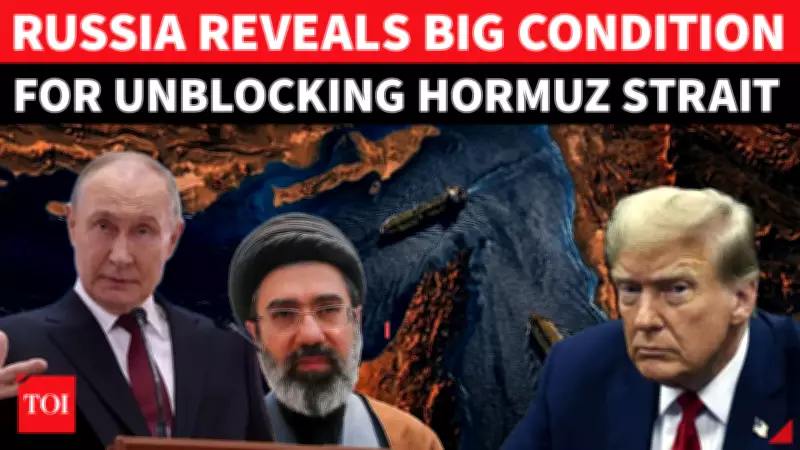
Russia Delivers Direct Warning to Trump Administration Over Iran Conflict
In a significant diplomatic development, Russian Foreign Minister Sergei Lavrov has issued a stark warning to the United States, declaring that normal shipping operations through the critical Strait of Hormuz will only resume if Washington halts its military actions against Iran. The statement came during a joint press conference in Moscow with Egypt's Foreign Minister Badr Abdelatty, as tensions in the Middle East continue to escalate dangerously.
Lavrov's Clear Ultimatum on Hormuz Stability
Speaking with deliberate gravity, Lavrov emphasized that the fundamental issue destabilizing the region is not Iran's defensive actions, but rather the ongoing military escalation initiated by the United States and its allies. The Russian diplomat framed the situation in unequivocal terms, stating that the security of one of the world's most vital maritime chokepoints directly depends on ending hostilities against Tehran.
"The restoration of normal commercial navigation through the Strait of Hormuz is contingent upon the cessation of military operations against Iran," Lavrov declared, making Russia's position unmistakably clear to the Trump administration. This represents Moscow's most direct intervention yet in the five-week-old conflict that has seen Iranian forces reportedly down multiple American aircraft.

Egypt Joins Diplomatic Push for De-escalation
Egyptian Foreign Minister Badr Abdelatty stood alongside Lavrov, echoing the call for immediate diplomatic solutions over military confrontation. This joint Russian-Egyptian position underscores growing international concern about the potential for the conflict to spiral into a broader regional war with devastating global consequences.
Abdelatty stressed the urgent need for all parties to return to negotiation tables, warning that continued military escalation threatens not only regional stability but global economic security. The Egyptian diplomat's presence alongside Lavrov signals a coordinated diplomatic effort among nations with significant interests in Middle Eastern stability.
Global Oil Supply Fears Intensify
As the conflict enters its fifth week, anxiety about potential disruptions to global oil supplies has reached new heights. The Strait of Hormuz serves as a transit route for approximately one-fifth of the world's petroleum consumption, making any threat to shipping through this narrow passageway a matter of urgent international concern.
World powers are intensifying behind-the-scenes efforts to prevent the situation from deteriorating further, with multiple diplomatic channels reportedly active despite the public military posturing. The economic implications of prolonged Hormuz instability could trigger global recessionary pressures, adding urgency to diplomatic initiatives.
Broader Conflict Prevention Efforts Accelerate
International mediators are working overtime to establish communication channels between the conflicting parties, with several European and Asian nations offering to host emergency talks. The complexity of the situation is compounded by Israel's involvement in the conflict, creating a multi-front confrontation that threatens to draw in additional regional actors.
Military analysts warn that the downing of American fighter jets by Iranian forces represents a significant escalation that could prompt retaliatory measures, potentially triggering a cycle of violence that becomes increasingly difficult to contain. The international community faces a critical test of its conflict resolution mechanisms as traditional diplomatic tools struggle to gain traction amid heightened military alert levels.
With global tensions at their highest point in years, the coming days will likely determine whether diplomatic pressure can prevail over military momentum in this dangerous confrontation that threatens to reshape Middle Eastern geopolitics and global economic stability.