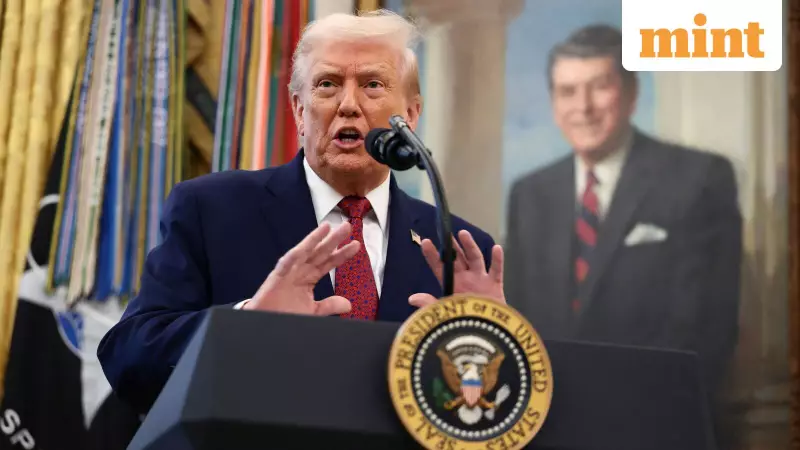
The unveiling of the United States' National Security Strategy (NSS) for 2025 has made one principle unmistakably clear: the doctrine of 'America First' remains the cornerstone of Washington's foreign policy under President Donald Trump. This unapologetic focus on US sovereignty and self-interest has direct implications for global partnerships, including the Quadrilateral Security Dialogue (Quad) involving India, the US, Australia, and Japan. For New Delhi, the document's tone and priorities offer a sobering lesson in geopolitical realism and underscore the imperative of strengthening its own strategic autonomy.
A Strategy of Self-Interest and Sovereignty
The NSS 2025, released on 17 December 2025, frames the world through a transactional lens. It views other nations primarily as potential markets, partners, or allies in maintaining a global environment conducive to American pursuits. The document expresses a deep-seated suspicion of multilateral institutions, a stance consistent with past US withdrawals from accords like the Paris Climate Agreement and the World Health Organization. While it makes a passing reference to a rules-based order, its core emphasis is on protecting US cultural, economic, and political sovereignty above all else.
This strategic shift leaves the future of the Quad under a question mark. A summit of Quad leaders, which was anticipated earlier in the year, now has only a narrow two-week window to materialise. The strategy's mention of the grouping is notably brief and functional. It speaks of keeping the Indo-Pacific "free and open" and aims to improve commercial and other ties with India to encourage its contribution to regional security, "including through continued [Quad] cooperation."

India's Envisioned Role: Partner on US Terms
The strategy outlines a specific, interest-driven role for India. It sees New Delhi as a partner to help secure the joint position of US allies not just in the Indo-Pacific but also in the Western Hemisphere. Furthermore, it seeks Indian cooperation in Africa concerning critical minerals and in ensuring freedom of navigation in the South China Sea, highlighting that India too would suffer if a "potentially hostile power" imposed a toll system on shipping lanes.
Although not always named explicitly, China is clearly cast as the primary rival, accused of unfair trade surpluses, industrial subsidies for supply chain dominance, intellectual property theft, and hegemonic ambitions. In this context, the acknowledgement of India as the only significant regional counterweight seems logical. However, the document also includes a controversial triangular link between India and Pakistan in a section on peace, a connection firmly denied by New Delhi. The US's silence on this contentious framing was, perhaps, predictable given the strategy's overall tenor.
Strategic Implications and India's Path Forward
As a nation committed to strategic autonomy, India is not obliged to formally respond to another country's policy document. However, the implications cannot be ignored. The strategy's dim view on immigration could reduce India's role as a talent pipeline for American corporations, though this may be offset by a faster rush to establish AI data and global capability centres within India itself.
More broadly, the strategy asserts a expansive US policy prerogative, with a modestly termed 'Trump Corollary' to the Monroe Doctrine effectively claiming agenda-setting rights for nearly half the globe. It suggests Europe should reconcile with Russia and halt NATO expansion, leaving Ukraine to temper its expectations. This represents a clear choice of hard-nosed geopolitical realism over idealistic posturing.
The critical question for India is the extent to which the Quad's agenda might drift amid these US priorities. While President Trump, via a US Embassy post on X, has called India an "important strategic partner" in the Indo-Pacific, the partnership is clearly conditional. Whether the Quad weakens or adapts, the lesson for India is unequivocal: it must redouble efforts to build its own strategic muscle. The focus must remain steadfastly on pursuing all elements within its control that serve Indian national interests, on its own terms and timeline.