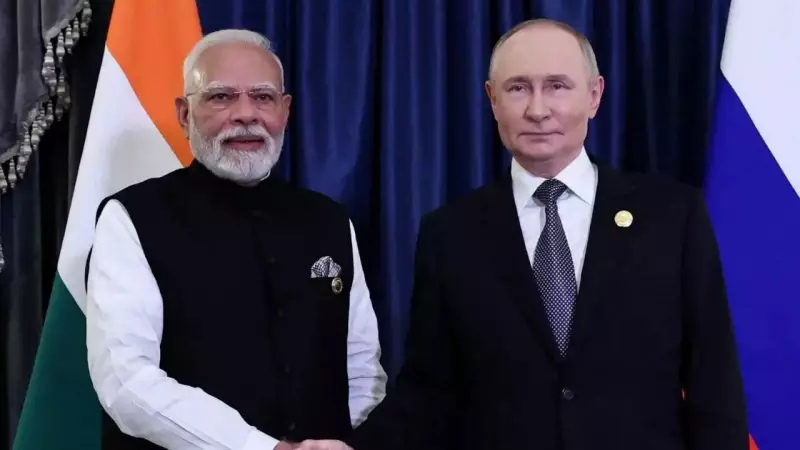
Russian President Vladimir Putin has declared Moscow's intention to significantly deepen its strategic partnership with India, aiming to elevate bilateral cooperation to what he termed a "qualitatively new level." This major announcement comes just ahead of his crucial two-day state visit to India from December 4 to 5.
Substantive Dialogue on Economic and Strategic Issues
Speaking at an investment forum in Moscow, Putin outlined the ambitious goal. He stated that Russia seeks to strengthen the technological component of its ties with both India and China. "We aim to elevate cooperation with the Republic of India to a qualitatively new level by strengthening its technological component," the President said.
He emphasized that this objective is the driving force behind numerous joint projects spanning critical sectors like energy, industry, space, and agriculture. Drawing a parallel with Russia's economic dialogue with Chinese President Xi Jinping, Putin expressed hope for continuing a similarly substantive discussion with Prime Minister Narendra Modi during the upcoming summit. A key part of these economic talks will focus on increasing imports of Indian goods into the Russian market.

Defence and Security: The Core of the Partnership
High-level defence agreements are expected to be a central pillar of the discussions. Kremlin spokesperson Dmitry Peskov confirmed that the agenda is likely to include the potential sale of additional regiments of the advanced S-400 Triumf long-range air defence missile systems to India.
Peskov highlighted the enduring strength of defence ties, noting that Russian arms still constitute about 36% of the Indian armed forces' inventory. He also indicated that talks on India's potential acquisition of Russia's fifth-generation stealth fighter, the Su-57, will move forward. "SU-57 is the best plane in the world. SU-57 will be on the agenda," Peskov stated.
He cited the successful BrahMos missile programme as a prime example of Indo-Russian defence collaboration, which goes beyond mere buyer-seller relations to involve a genuine exchange of high technologies. With Russian-origin Sukhoi-30 jets forming the bulk of India's fighter fleet, the offer of the Su-57 is a significant development, though Indian officials have clarified that no decision has been taken yet.
Nuclear Energy and Broader Cooperation
Beyond defence, the summit may yield progress in civilian nuclear energy. Peskov confirmed the possibility of an agreement, with Russia prepared to offer its expertise in small and flexible nuclear reactor technology. He referenced Russia's deep involvement in building the Kudankulam Nuclear Power Plant and expressed hope for the continuation of such projects.
Despite fluctuations in crude oil purchases due to international pressure, India has shown no intent to scale back defence engagement with Moscow. As recently as last week, Defence Secretary Rajesh Kumar Singh indicated that discussions on additional S-400 units are likely.
Analysts observe that while the trading relationship faces strains under the threat of sanctions, the defence sector continues to be the primary bond. "A large part of the trading relationship was based on energy, which is now losing traction... And at the end of the day, only defence remains, which continues to bind the two together," said Harsh Pant of the Observer Research Foundation.
The 23rd India-Russia Annual Summit, hosted at the invitation of PM Modi, is therefore poised to be a defining moment, setting the trajectory for the next phase of this time-tested strategic partnership amidst a complex global landscape.