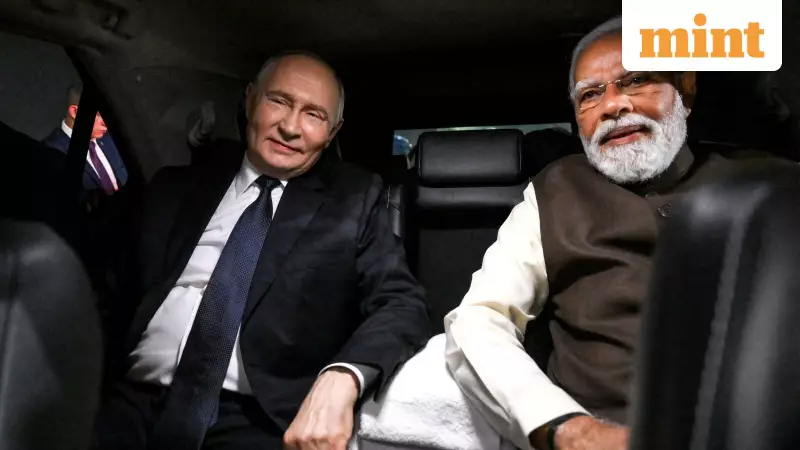
Russian President Vladimir Putin is set for crucial summit talks with Prime Minister Narendra Modi in New Delhi on Friday, marking the final day of his two-day official visit to India. This high-level engagement represents the 23rd Annual India-Russia Summit, a pivotal diplomatic event held at the historic Hyderabad House.
Schedule and Significance of the Visit
This marks President Putin's first trip to India in four years, arriving at a geopolitically sensitive juncture. The meticulously planned itinerary for the final day includes a ceremonial reception at Rashtrapati Bhavan at 11 AM, followed by a solemn wreath-laying ceremony at Rajghat. The core summit talks with PM Modi are scheduled for 11:50 AM at Hyderabad House, concluding with press statements at 1:50 PM. Later, Putin will meet President Droupadi Murmu at 7 PM before his departure at 9 PM.
The timing of the visit is particularly noteworthy. It comes as New Delhi is concurrently engaged in trade negotiations with the United States, seeking relief from punitive tariffs imposed during the Trump administration—a move partly linked to India's continued purchases of Russian oil. Putin's arrival in India followed closely on the heels of his discussions with top US envoys regarding a potential peace deal for Ukraine, though those talks did not yield a compromise.

Navigating Global Pressure and Deepening Bilateral Ties
India has maintained a consistent stance of not condemning Russia over the conflict in Ukraine, advocating instead for peace through dialogue and diplomacy. New Delhi has argued that its longstanding relationship with Moscow is being unfairly scrutinized by Western nations, which themselves continue business with Russia when it suits their interests.
The core agenda of the summit, as reported by Reuters, is to significantly boost bilateral trade, which has been heavily impacted by Western sanctions. Russia aims to elevate the total trade volume to $100 billion by 2030. Currently, trade is skewed in Moscow's favour, primarily due to India's substantial energy imports, including seaborne Russian oil. As the top buyer of Russian arms and a major importer of its oil, India plays a critical role for Russia's economy under sanctions.
Expanding the Partnership Beyond Defence
For decades, Moscow has been India's foremost supplier of defence equipment. The summit is expected to reinforce this partnership while also diversifying into new areas. Beyond defence and energy, PM Modi and President Putin are anticipated to discuss cooperation in civil nuclear energy and labour mobility. Several new agreements are expected to be announced, designed to showcase the resilience and adaptability of the India-Russia strategic partnership in a changing global order.
The leaders' exchange of gifts also carried symbolic weight, with PM Modi presenting President Putin a Russian translation of the Bhagavad Gita, underscoring the cultural and philosophical connection between the two nations. This summit reaffirms the intent of both countries to navigate complex international dynamics while strengthening a relationship built on decades of mutual trust and strategic alignment.