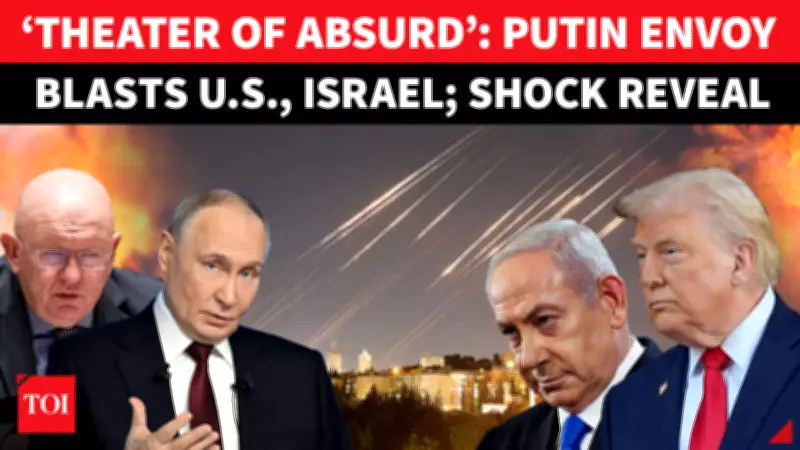
Russia's UN Ambassador Launches Fierce Attack Over Iran Resolution
In a dramatic United Nations Security Council session, Russia's permanent representative Vasily Nebenzia unleashed a blistering critique of the United States and Israel regarding the ongoing Middle East crisis. The Russian diplomat claimed the newly adopted resolution deliberately ignored what he called the "root causes" of regional tensions while effectively providing justification for military actions targeting Iran.
Explosive Allegations of Diplomatic Pressure
Nebenzia made the startling assertion that multiple delegations faced intense pressure during the voting process, suggesting their arms were metaphorically "twisted" to secure support for the resolution. "Some delegations were subjected to undue influence during this vote," the ambassador declared without naming specific countries, though his remarks clearly pointed toward Washington's diplomatic efforts.
The Russian envoy went further by alleging that the United States might have been planning military operations against Iran even while diplomatic negotiations with Tehran were supposedly ongoing. This dual-track approach, according to Nebenzia, represented a fundamental breach of diplomatic trust and undermined genuine peace efforts in the volatile region.

Context of Escalating Regional Tensions
These explosive comments come against a backdrop of dramatically escalating hostilities following a joint United States-Israel military operation against Iranian targets. That coordinated action triggered immediate retaliation from Iran, which launched numerous missiles and drones across multiple locations throughout the Middle East, creating a dangerous cycle of military escalation.
The Security Council debate focused specifically on addressing the rapidly deteriorating situation, with Nebenzia arguing that the adopted resolution failed to acknowledge what Russia views as the underlying drivers of conflict. Instead, he contended, the document effectively legitimized offensive military actions while ignoring diplomatic alternatives that might de-escalate tensions.
Key Points from Nebenzia's Statement:- The UN resolution ignored fundamental causes of Middle East instability
- Multiple delegations faced pressure during the voting process
- The United States may have planned military operations during diplomatic talks with Iran
- The resolution effectively justified military actions against Iran
- Current approaches undermine genuine peace efforts in the region
Broader Implications for International Diplomacy
Nebenzia's remarks highlight deepening divisions within the United Nations Security Council regarding how to address the Iran conflict. The allegations of diplomatic pressure raise serious questions about the integrity of multilateral decision-making processes during times of international crisis. Furthermore, the suggestion that military planning occurred alongside diplomatic engagement points to potential coordination failures that could exacerbate rather than resolve conflicts.
As regional tensions continue to escalate with missile exchanges and military operations, diplomatic channels appear increasingly strained. The Russian ambassador's forceful intervention underscores how major power rivalries are playing out within UN forums, with accusations and counter-accusations potentially complicating efforts to find peaceful resolutions to the Middle East crisis.