Pakistan Defence Minister's Parliament Admission Exposes Terror-Corruption Nexus
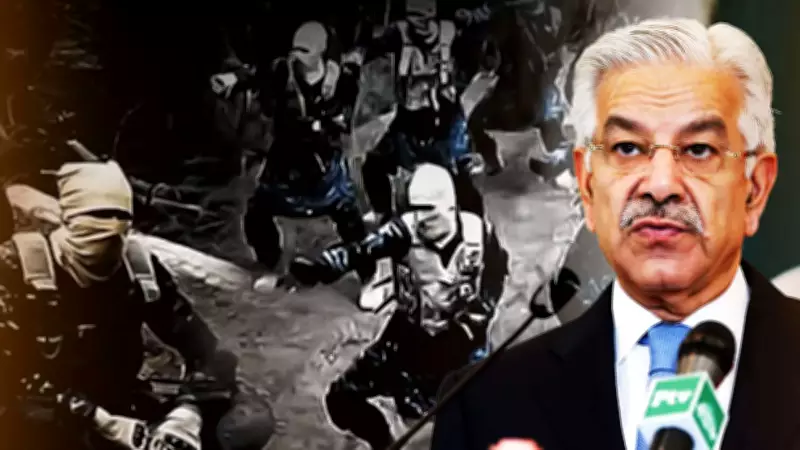
In a significant development that has sent shockwaves through regional security discussions, Pakistan's Defence Minister Khawaja Asif has made a startling admission before the country's Parliament. The minister openly acknowledged that terrorism within Pakistan is fundamentally rooted in corruption and smuggling networks, rather than foreign interference as previously claimed by Islamabad.
Balochistan Violence Driven by Criminal Profits
During his parliamentary address, Asif specifically addressed the ongoing violence in Balochistan, revealing that criminal profits rather than external forces are the primary drivers of instability in the region. The minister disclosed that sophisticated oil smuggling operations generate billions of rupees annually, with these substantial funds directly flowing to militant groups operating across Pakistan.
This revelation fundamentally contradicts Pakistan's longstanding narrative that has typically blamed neighboring countries for supporting terrorism within its borders. Asif's statement represents a dramatic shift in official Pakistani discourse regarding the sources of terrorist financing and operational support.

Scale of Casualties and Criminal-Terror Nexus
The defence minister further revealed alarming details about the human cost of this criminal-terror nexus, providing statistics on casualties among both civilians and security forces. Perhaps most significantly, Asif admitted that numerous criminal organizations within Pakistan operate under the banner of officially banned terrorist outfits, creating a complex web of illicit activities that sustains violence and instability.
This admission confirms what security analysts have long suspected: that Pakistan's internal criminal networks and terrorist organizations maintain symbiotic relationships that benefit both entities financially and operationally.
Vindication for India's Long-Held Position
Minister Asif's parliamentary statement provides substantial validation for India's consistent international position regarding Pakistan-based terrorism. For years, New Delhi has highlighted at global forums that Pakistan's terror infrastructure thrives on internal institutional corruption and complicity, rather than external support.
India has repeatedly presented evidence of this corruption-terror nexus to international bodies, arguing that Pakistan's internal governance failures create an environment where terrorist organizations can flourish with impunity. The Pakistani defence minister's admission now gives official credence to these long-standing Indian assertions.
Exposing Islamabad's Denial Strategy
The significance of Asif's statement lies not just in its content but in its source. Coming from Pakistan's own defence minister, the admission exposes the reality that Islamabad has systematically attempted to deny in international diplomatic circles for decades. This represents a potential turning point in how Pakistan addresses terrorism internally and discusses it externally.
Security experts suggest this admission could signal a shift in Pakistan's approach to counterterrorism, potentially moving toward greater transparency about the domestic roots of terrorist financing and operations. However, questions remain about whether this represents genuine policy change or merely rhetorical adjustment in response to mounting evidence.
The international community will be watching closely to see if Pakistan follows this admission with concrete actions to dismantle the corruption networks that Asif has now officially acknowledged fund terrorism within the country.