NASA's Space Umbrella Project Enlists Public to Study Solar Wind Impact on Earth
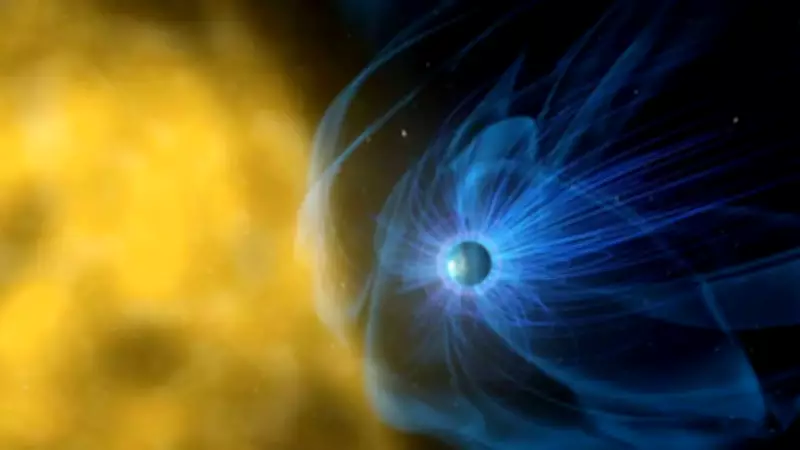
The Sun continuously emits a stream of charged particles known as the solar wind, which travels across space and reaches Earth daily. Upon arrival, this energetic flow encounters Earth's magnetic field, an invisible protective shield that deflects and redirects much of this energy away from the planet's surface. The dynamic boundary between these two forces is constantly shifting and active, presenting a critical area for scientific investigation.
NASA's Magnetospheric Multiscale Mission and Magnetic Reconnection
Since 2015, NASA has been closely examining this interaction zone through its Magnetospheric Multiscale Mission (MMS). The spacecraft was specifically launched to observe a fundamental process called magnetic reconnection. This phenomenon occurs when the magnetic fields from the Sun and Earth temporarily connect and then violently separate, releasing significant bursts of energy. Although this process operates on a relatively small scale, its effects are profound, influencing the formation of auroras and driving space-weather conditions that propagate through near-Earth space.
Scientists monitor these energetic exchanges because the released energy can disrupt satellites, interfere with GPS signals, and disturb radio communication systems. Additionally, astronauts operating beyond the densest layers of Earth's atmosphere face increased radiation exposure during intense solar events. The MMS mission provides highly detailed measurements of these interactions, but analyzing the vast amounts of data requires considerable time and effort.

Public Participation Through the Space Umbrella Project
To expand this research effort, NASA established the Space Umbrella project, which actively involves members of the public in reviewing mission data. Volunteers are tasked with examining visual data from MMS instruments and identifying periods when solar activity and Earth's magnetosphere interact most strongly. A concise online tutorial guides participants on how to recognize when the spacecraft is within the magnetosphere versus when it traverses more turbulent regions influenced by the solar wind.
No prior scientific training is necessary for this observational task. The project relies on the collective contributions of many volunteers to build a comprehensive dataset that researchers can use to refine models of solar storms and space weather. While individual efforts may not lead to dramatic discoveries, they incrementally add to a broader understanding of how solar phenomena affect technology and human activities in space.
Significance for Space Weather Research
The collaborative approach of the Space Umbrella project enhances NASA's capability to study solar storms and their potential impacts. By engaging the public in data analysis, the project accelerates the identification of key interaction events, contributing to improved predictions and mitigation strategies for space-weather-related disruptions. This initiative underscores the importance of public involvement in advancing scientific knowledge and safeguarding critical infrastructure from solar influences.