

NASA Unveils Comprehensive Space Strategy at Ignition Event
NASA has revealed a wide-ranging set of agencywide initiatives during its "Ignition" event, outlining ambitious plans to expedite the return to the Moon, establish a long-term lunar presence, shape the future of low Earth orbit, expand science missions, and advance nuclear propulsion technology. These efforts align with President Donald Trump's National Space Policy, emphasizing American leadership in space exploration.
Administrator's Vision for Rapid Progress
NASA Administrator Jared Isaacman emphasized the urgency of the mission, stating, "NASA is committed to achieving the near-impossible once again, to return to the Moon before the end of President Trump’s term, build a Moon base, establish an enduring presence, and ensure American leadership in space. Success or failure will be measured in months, not years, in this great-power competition."
Updated Moon Strategy and Artemis Program
The centerpiece of the announcement is NASA's updated Moon strategy, building on earlier Artemis changes. This includes standardizing the Space Launch System rocket, adding a mission in 2027, and targeting at least one lunar surface landing annually thereafter. Artemis III, scheduled for 2027, will test integrated systems in Earth orbit ahead of the Artemis IV lunar landing. Beyond Artemis V, NASA plans to incorporate more commercially procured and reusable hardware for frequent, affordable crewed missions, initially aiming for landings every six months.

Phased Approach to Lunar Base Construction
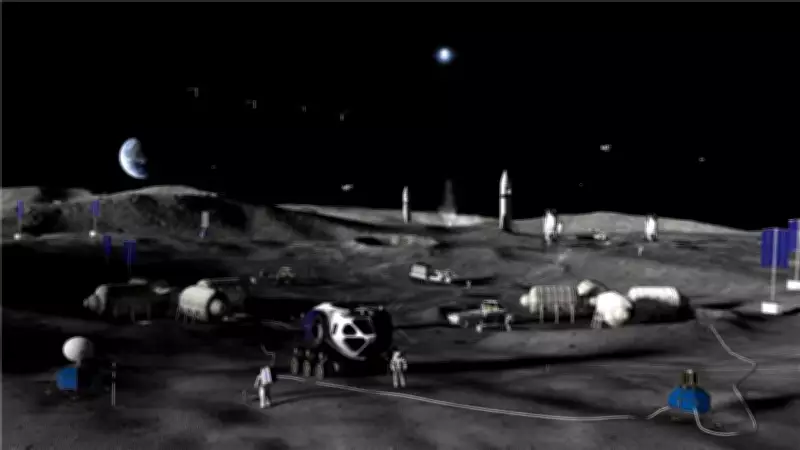
NASA announced a phased approach to building a Moon base for sustained human presence. The agency will pause the Gateway in its current form and focus on infrastructure supporting surface operations. The plan unfolds in three phases:
- Build, Test, Learn: Use Commercial Lunar Payload Services and Lunar Terrain Vehicle programs for rovers, instruments, and technology demonstrations.
- Establish Early Infrastructure: Introduce semi-habitable infrastructure and regular logistics, incorporating international contributions like JAXA's pressurized rover.
- Enable Long-Duration Human Presence: Deploy cargo-capable human landing systems for heavier infrastructure, including ASI's Multi-purpose Habitats and CSA's Lunar Utility Vehicle.
Expansion of Lunar Science Missions
NASA aims to accelerate lunar science with up to 30 robotic landings starting in 2027, speeding up payload deliveries. Missions will include rovers, hoppers, and drones, with contributions from industry, academia, and international partners. Near-term payloads feature the VIPER rover and LuSEE-Night mission. An RFI released March 24 seeks payloads for 2027-2028 flights and future Mars missions, offering opportunities for students and researchers nationwide.
Transition in Low Earth Orbit
Beyond the Moon, NASA reaffirmed its commitment to low Earth orbit while planning for the International Space Station's eventual end. The agency introduced a phased, ISS-anchored approach, procuring a government-owned Core Module attached to the station, followed by commercial modules tested using station capabilities. Once mature, these stations would separate, with NASA becoming a customer for commercial services. An industry RFI opens March 25 to expand opportunities like private astronaut missions and joint missions.
Nuclear Propulsion Mission to Mars
In a major announcement, NASA will launch Space Reactor-1 Freedom, the first nuclear-powered interplanetary spacecraft, to Mars before the end of 2028. This mission demonstrates advanced nuclear electric propulsion in deep space, offering efficient mass transport and supporting high-power missions beyond Jupiter. Upon reaching Mars, SR-1 Freedom will deploy Ingenuity-class helicopters for exploration, establishing flight heritage and regulatory precedent for future fission power systems.

Rebuilding Agency Capabilities
NASA is restoring core competencies by converting thousands of contractor positions to civil service and strengthening its engineering base. The agency is expanding opportunities for interns and early-career professionals, creating pathways for industry talent through term-based appointments. Teams will embed experts across the supply chain to accelerate production and ensure successful outcomes.
These initiatives will be implemented over the coming months as NASA works to maintain key programs and partnerships, driving forward a new era of space exploration.





