

Myanmar's Exiled Government Launches Federal Steering Council as Junta Leader Advances to Civilian Role
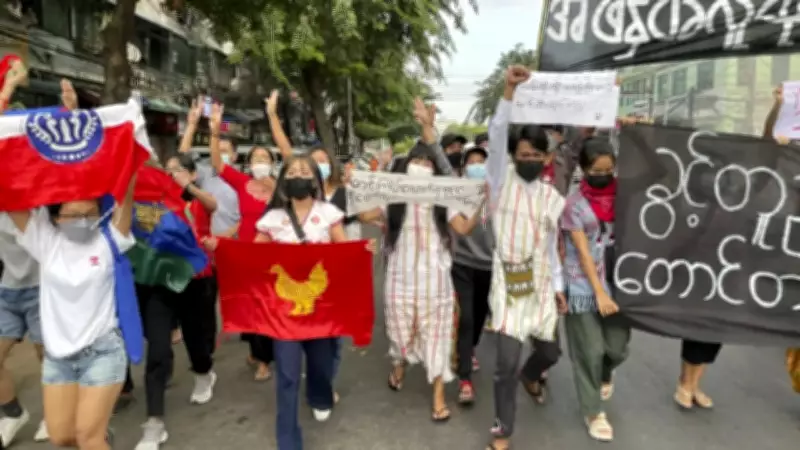
In a significant political development, Myanmar's exiled National Unity Government (NUG) has announced the formation of the Steering Council for the Emergence of a Federal Democratic Union (SCEF). The NUG, established by elected lawmakers ousted in the 2021 military coup, revealed this initiative in a statement shared with media outlets. According to the NUG, SCEF's primary objective is to "completely dismantle all forms of dictatorship, including the military dictatorship, and to collectively initiate a new political landscape that can effectively and practically realise our political aspirations and positions."
Composition and Goals of the New Council
The newly formed SCEF includes various ethnic resistance organizations, such as the Kachin Independence Organisation (KIO), Karen National Union (KNU), and Chin National Front (CNF), among others. This coalition aims to represent diverse factions within Myanmar's ongoing resistance movement. The council is structured around three foundational pillars:
- The pillar representing states, federal units, and ethnic resistance organizations (EROs).
- The pillar representing the people.
- The pillar representing women, designed to coordinate, lead, guide, and implement military, political, federal, and institutional matters.
In its statement, the NUG emphasized that SCEF is "committed to protecting and promoting the diverse identities of all ethnic nationalities residing within member states and units of the Union, and to firmly building a new Federal Democratic Union composed of states that fully guarantee equality among nationalities and the right to self-determination." Additionally, the body stresses principles of "shared sovereignty" between the Union and the states or federal units, along with "collective leadership" to ensure meaningful inclusion of voices from EROs, democratic resistance forces, women's groups, and people's representatives.

Junta's Political Maneuvers Amidst Resistance
This development coincides with key political moves by Myanmar's military junta. Junta chief Min Aung Hlaing, who has led the country since the 2021 coup, was recently elected as a vice-president by the lower house of parliament. This step edges him closer to becoming Myanmar's civilian leader, initiating a transition from military to civilian leadership. The process involves parliament appointing three vice-presidents, with one set to become president. The upper house has already elected Nan Ni Ni Aye, a lawmaker from the military-aligned Union Solidarity and Development Party (USDP) representing Karen State, as another vice-president. The military will appoint the third vice-president, with a full parliamentary vote to select the president from these three expected this week.
Democracy watchdogs have long cautioned that the new government is likely to serve as a proxy for the military, which has dominated Myanmar's governance for most of its post-independence history. This concern underscores the deep-seated tensions between the junta's consolidation of power and the resistance efforts led by groups like the NUG and SCEF.
Leadership Changes Within the Military
In a parallel development, Myanmar's military leadership is undergoing a transition. Ye Win Oo, a 60-year-old former intelligence chief, is set to take over as the new military leader. Notably, Ye Win Oo led the troops that arrested Nobel Peace Prize winner and former leader Aung San Suu Kyi on February 1, 2021. Reuters reports that his selection, marking the first time an intelligence chief has reached the top military post, is largely due to his close ties and loyalty to outgoing commander Min Aung Hlaing.

Naung Yoe, a major who defected from the military after the 2021 coup, commented, "Min Aung Hlaing has chosen to hand over power to his most trusted inner circle loyalist." Although Myanmar's military intelligence generals are known for their brutality, analysts predict that the early phase of Ye Win Oo's leadership will align closely with Min Aung Hlaing's priorities, especially as the latter moves toward a prospective presidency. One analyst told Reuters, "For at least two years, the commander-in-chief will be compliant to the president," adding that a major overhaul of the military's war doctrine is unlikely as it continues to combat armed groups across extensive regions of the country.
These events highlight the complex and volatile political landscape in Myanmar, where exiled resistance forces are organizing for federal democracy while the military junta reinforces its control through strategic leadership changes and political transitions. The formation of SCEF represents a concerted effort by the NUG to unite ethnic groups and democratic elements against military rule, setting the stage for continued conflict and diplomatic challenges in the region.





