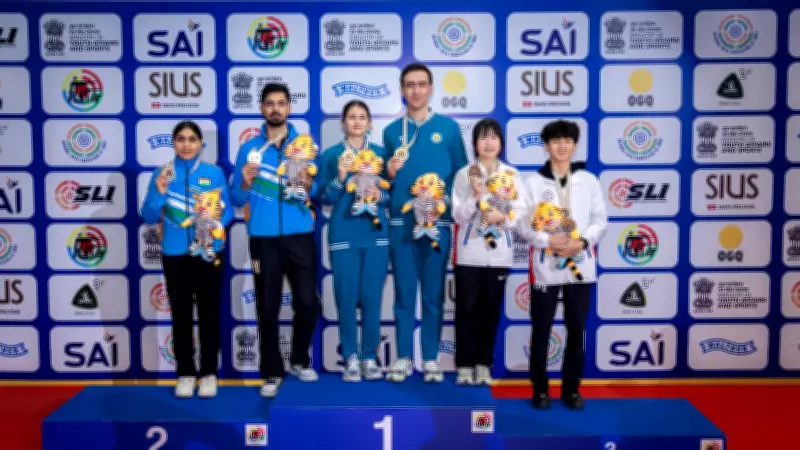
Indian Shooting Duo Overcomes Format Surprise to Claim Asian Championship Silver
In a remarkable display of mental fortitude and adaptability, young Indian shooters Suruchi Phogat and Samrat Rana secured a silver medal at the Asian Shooting Championship despite being caught off-guard by a sudden format change in the 10m air pistol mixed team event. The promising duo, who entered the competition expecting a straightforward medal path, found themselves navigating an entirely new competitive structure that tested their resilience at the Dr Karni Singh Shooting Range in Delhi.
Unexpected Challenge on the Shooting Range
Typically, topping the qualification stage in mixed team shooting events guarantees a medal position, with first or second place securing either gold or silver. This conventional understanding led Phogat and Rana to believe their qualification success had already assured them a podium finish. However, as they prepared for what they thought would be a standard final, range officials introduced them to a completely revised competition format that eliminated any guaranteed medals.
The new structure transformed the event into a four-team contest featuring an initial fifteen-shot stage followed by elimination rounds. This meant that despite their strong qualification performance, the young shooters now faced the real possibility of leaving empty-handed in what marked the first international implementation of these updated rules.

Mental Adjustment Under Pressure
Phogat, a 19-year-old shooting prodigy who dominated the 2025 ISSF World Cup circuit with three victories before experiencing disappointment at the World Championships, described the moment of realization. "When you are in a playoff for the gold medal, you're not very scared. But here suddenly I felt like 'Yeh kya ho gaya' (What has happened)," she revealed after the medal ceremony.
Her partner, 21-year-old Samrat Rana from Karnal, faced his own challenges during the final. Competing without friends or family in the stands, Rana consistently became the last shooter to release his shot among the eight competitors on the lane. His hesitation stemmed from an understandable but problematic approach: "I kept waiting for the perfect shot," he admitted.
Coaching Intervention and Technical Adjustment
With India trailing eventual gold medalists Kamalov Mukhammad and Nigina Saidkulova of Uzbekistan by two significant points after eighteen shots, national pistol coach Samaresh Jung called a crucial timeout. Observing Rana's delayed shooting rhythm, Jung provided immediate corrective guidance that proved instrumental in India's comeback.
"He told me that I was firing my shot late. After that, I tried to shoot a little quicker," explained Rana, whose father had originally coached him using village targets before ensuring his son received proper professional training to avoid similar limitations.
Broader Context and Future Challenges
Despite their silver medal achievement in what some considered a depleted field, both shooters recognize the need for continued technical refinement. Phogat, currently without a personal coach and alternating between national team guidance and her father's supervision, acknowledged the importance of systematic improvement. "When we are winning, it's easy to not care about your technique. But when results start getting up and down, you have to go through everything that you do and find out what's going wrong," she reflected.
Rana carries the legacy of being coached to a World Championship gold by his father, joining the elite company of Indian shooting legends Abhinav Bindra and Rudrankksh Patil. This background adds to the expectations surrounding his career development.
Looking Ahead to Busy Competitive Calendar
The Asian Championship silver arrives at a critical juncture for both athletes as they prepare for a demanding schedule featuring domestic trials, the Asian Games, and further World Championships. Their ability to adapt to unexpected format changes while maintaining competitive performance suggests promising potential, but consistent technical work remains essential for meeting the lofty standards they've established through previous successes.

This experience at the Asian Shooting Championship serves as both an achievement and a learning opportunity, demonstrating that modern competitive shooting requires not just technical precision but also mental flexibility when facing procedural surprises. As Indian shooting continues to develop world-class talent, stories like Phogat and Rana's adaptation under pressure highlight the multifaceted nature of elite athletic performance.