

Jallianwala Bagh Massacre: 107 Years Later, The Unhealed Scar of British Brutality
On April 13, 1919, the sun rose over Amritsar with the familiar sharp intensity of Punjab's spring. The city was alive with Baisakhi celebrations, filled with the scent of ripening grain, the rhythmic beats of dhol drums, and the spiritual energy radiating from the Golden Temple. Yet, just a few hundred meters away, behind a narrow, unassuming alleyway, time stood frozen in a place of profound tragedy.
Within the red-brick walls of Jallianwala Bagh, the clock has been stopped for 107 years. This is not merely a garden but a crime scene that remains the deepest scar on the conscience of the British Empire. On this day in 1919, the promise of British justice was revealed as a hollow shell, replaced by ten minutes of calculated, cold-blooded slaughter that would forever alter the course of India's freedom struggle.
The Tinderbox of Colonial Punjab
To comprehend the tragedy, one must understand British-ruled Punjab in early 1919. The First World War had ended, and Indian soldiers who had fought valiantly for the Crown returned home expecting the reward of self-governance. Instead, they encountered the Government of India Act 1919, which introduced limited reforms while retaining crucial powers under British control.

Compounding this disappointment was the Anarchical and Revolutionary Crimes Act of 1919, infamously known as the Rowlatt Act. This draconian legislation granted colonial authorities emergency powers to detain anyone suspected of sedition without trial for up to two years. The resulting anger sparked protests across several cities, including Amritsar.
The tension reached its breaking point on April 10, 1919, when British authorities summarily arrested and deported two beloved local leaders, Dr. Saifuddin Kitchlew and Dr. Satyapal. Violence erupted, and Punjab was placed under martial law. Into this volatile atmosphere stepped Reginald Dyer, the man who would soon become synonymous with one of history's most infamous massacres.
April 13, 1919: The Harvest of Blood
The morning of Baisakhi was deceptively peaceful. While General Dyer patrolled the city reading a proclamation banning all public gatherings, the message never reached thousands of pilgrims arriving from rural Punjab. By mid-afternoon, a crowd had swelled in Jallianwala Bagh—a seven-acre plot of uneven land surrounded by the backs of houses.
According to the Hunter Commission Report, approximately 15,000-20,000 people had gathered by 5 PM. While some were there to hear speeches protesting the Rowlatt Act, many were families, women, children, and elderly pilgrims simply resting after their journey. Eyewitness accounts confirm the crowd was unarmed and showed no signs of organized rebellion.
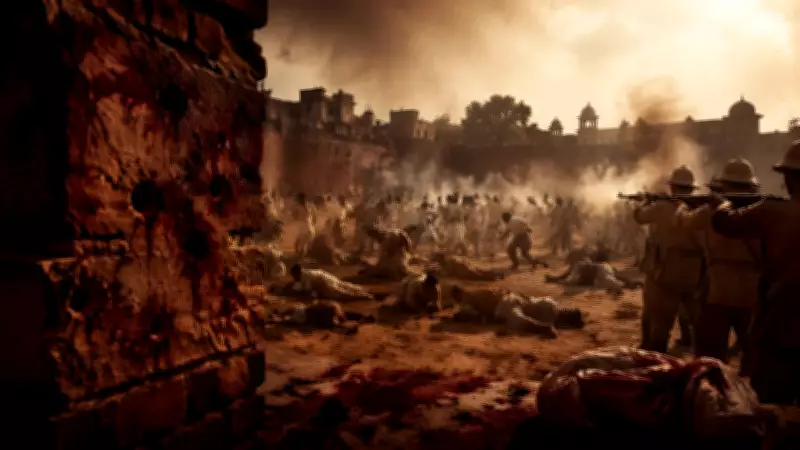
At 5:15 PM, General Dyer entered the Bagh with 50 soldiers armed with .303 Lee-Enfield rifles. He positioned himself on a raised mound near the main entrance. In his later testimony, Dyer chillingly admitted, "If I could have got the armored cars in, I would have used them."
Without any warning, the firing began.
Ten Minutes of Eternity
For ten agonizing minutes, the only sounds in Amritsar were the mechanical crack of rifles and the primal screams of the trapped. Dyer ordered his men to fire specifically where the crowd was thickest. As people scrambled toward the five narrow exits, they found most locked or blocked by soldiers.
The geography of Jallianwala Bagh created a perfect death trap. High walls surrounded three sides, with soldiers positioned on the fourth. People attempting to scale the walls were picked off like targets. In one corner stood a deep, open well where hundreds—mothers holding infants, young boys, the aged—leapt to escape the bullets, choosing drowning over gunfire.
The firing stopped only when 1,650 rounds had been expended. General Dyer then issued his final order: to leave. No medical aid was provided, no ambulances called, no water offered to the wounded. A curfew was enforced, meaning anyone stepping out to search for loved ones would be shot on sight.

The 'Moral Stature' of a Monster
What makes Jallianwala Bagh uniquely horrifying isn't merely the body count but Dyer's cold justification. During the Hunter Commission hearings, when asked if he had attempted to disperse the crowd before firing, Dyer responded, "No, at the time it did not occur to me. I had made up my mind... if they were going to give me an opportunity of using my guns, I was going to take it."
He stated his intention was to "strike terror throughout the Punjab" and reduce the "moral stature" of rebels. When questioned about not tending to the wounded, his response reflected the colonial psyche: "It was not my job."
Shockingly, sections of British society hailed Dyer as a hero. The House of Lords supported him, and a fund started by the Morning Post raised £26,000 for the "Saviour of the Punjab." This endorsement of mass murder became the final nail in the coffin of Indian loyalty to the Crown.
The Official Lie Versus Human Truth
The British cover-up began immediately. The official Disorders Inquiry Committee (Hunter Commission) reported 379 deaths. However, the Indian National Congress, through an independent inquiry led by Madan Mohan Malaviya and Motilal Nehru, estimated over 1,000 deaths and more than 1,500 wounded. Many victims' names were never recorded—they were pilgrims whose families in distant villages simply never saw them return.
The Aftermath: Awakening a Sleeping Giant
Jallianwala Bagh transformed India's freedom movement from petitioning to revolutionary. News of the massacre, though censored, ignited nationwide outrage. Rabindranath Tagore renounced his Knighthood, writing to Viceroy Lord Chelmsford, "The time has come when badges of honor make our shame glaring in the incongruous context of humiliation."
Mahatma Gandhi, deeply affected, intensified his campaign against British rule, launching the Non-Cooperation Movement in 1920. He declared cooperation with a "Satanic" government a sin, writing in Young India, "This satanic government cannot be mended, it must be ended."
A 20-year-old witness, Udham Singh, took a handful of blood-soaked earth and swore revenge. Twenty-one years later, in 1940, he assassinated Michael O'Dwyer, the Lieutenant-Governor of Punjab who had sanctioned Dyer's actions.
A Scar That Never Healed
For Punjab, Jallianwala Bagh became a symbol of pain and resistance. The site transformed from ordinary garden to sacred ground. Bullet marks on walls, the narrow entrance, and the Martyrs' Well stand as silent witnesses to this day.
More than a century later, justice remains elusive. While British Prime Ministers David Cameron and Theresa May expressed regret in 2013 and 2019 respectively, no formal, unequivocal apology has been issued by the British government.
Why It Still Matters
On April 13, 1919, people gathered at Jallianwala Bagh had no idea they were stepping into history. They came for meetings, festivals, and togetherness. What they encountered was violence echoing through generations.
Today, visitors walk through Jallianwala Bagh in silence, feeling the weight of history. They pause by the well, run hands over bullet-scarred walls, and read names etched in stone. This is not merely a memorial but a reminder that freedom was not given—it was fought for at unimaginable cost.
As India marks 107 years since that fateful day, Jallianwala Bagh remains deeply relevant. It reminds us of:
- The cost of unchecked power
- The fragility of civil liberties
- The strength of collective memory
- How single events can alter history's course
The massacre did not silence India—it strengthened its resolve. Not just in the walls of Jallianwala Bagh, but in the memory of a nation that refuses to forget.





